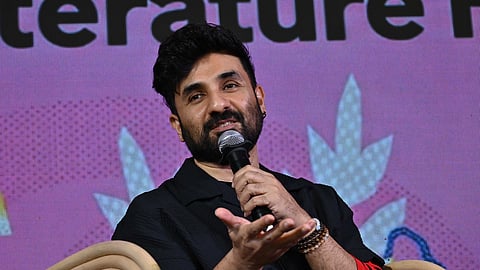

As Vir Das enters the Bangalore Literature Festival (BLF) stage with the kind of disarming candour he is known for and breaks the ice instantly, it dissolves the line between a performer and the audience. He jokes about everything, yet keeps it intense and subtle at the same time and looks around the crowd, half-amused, half-awed, as if he has entered a room he isn’t sure he deserves to be in, a theme that runs through his new memoir, The Outsider: A Memoir for Misfits. “It’s my first literature festival ever, I’m arguably the stupidest person here,” he quips.
With the recently released book in his hand, he notes that writing has quietly shaped him as a mirror of his life. “Writing a book forced me to confront my life,” he shares. Stand-ups, Das says, are always moving – there’s neither time for celebration nor introspection, but writing the book changed that. “When you write a book about your life, you to confront it. I realised what a backlog of things I hadn’t dealt with in years.”
When asked how BLF compares to other events, he shrugs. “Never been to one before. I’m hoping the others are this good. It’s different from a stand-up show. Everybody’s sober here,” Das laughs, adding that what stays with him is the people: “I got to spend five seconds with so many people today and just be awed by how intelligent and passionate they are. I don’t know if I’ll ever have a massive audience. But I think I have a massively passionate audience, and that’s a far greater privilege.”
The signing process at the event, he says, filled him with unexpected gratitude. “It made me 300 per cent more grateful for the journey I had, for the people I’ve met, for the cumulative effect they’ve had on me.” That, he believes, is the book’s core: remembering the people who carried him. Yet he hopes the readers carry a moment of what he felt while writing the memoir, which is that ‘it’s okay to feel lost’. “It’s okay not to belong, or to be an outcast. All of that is an identity you can hold,” he points out.
During the session, he went deeper into this idea, as he stated, “I’ve been a boarding school kid in Delhi Public School, a DPS kid in Galesburg, Illinois, an Indian accent in American drama school, a westernised accent in Indian movies... I’ve never fully belonged.” The memoir grew from this space – the sense of gatecrashing every world he entered. “You’re sitting at a party thinking, ‘How the hell did I get invited here?’ But I think most people feel that way. They just don’t say it,” he jokes, noting how success didn’t smooth the edges.
You ask him about courage, especially in a world where his jokes have invited FIRs, abuse and even threats, he says, “I’m always scared. Ninety per cent of it is pretending you’re brave. Fear is in the room; you acknowledge it, just don’t judge it.” He also laughs about being told to “keep quiet and do gym jokes,” but stand-up, he insists, relies on authenticity. “If you’re apolitical in your 40s, what kind of life have you had?,” he asks.
Yet amidst the hullabaloo, the role that feels closest to him today is directing. “ I just made my first movie, Happy Patel (bankrolled by Aamir Khan Productions, teaser of which was released recently), and I just fell in love with directing. It’s indeed the accumulation of everything I’ve learned – writing, performance, storytelling,” he says, winding up the chat with a wide smile.

"Sadly, many Indians do not know their mother tongue well. Many of the youngsters are reading Hindi in the Roman script, not in the original Devanagari script"
"I have written 25 books for children because many parents, grandparents and teachers are busy, and children need stories with good values"
"There’s an assumption that movies are the ultimate prize. Even I believed that. But it’s no longer the focus. The entertainment industry is fun but stressful"
* With the 14th edition of the Bangalore Literature Festival taking place at Freedom Park – cherished for its open atmosphere – the space proved to be more than just any other. It offered a sense of breathing room right in the heart of the city, allowing visitors to immerse themselves in its history and stories. The Central Jail, back in the day, the space came alive with session venues being named watchtower, open cell, left barrack and right barrack.
* Despite travel disruptions due to flight cancellations, many speakers made it to the Freedom Park. The much-anticipated session with English-Vinglish filmmaker Gauri Shinde was cancelled.
* While the space was spruced up for the event, it faced challenges a few issues in accommodating the crowds, especially with limited washroom facilities.
* The festival’s first day saw a higher footfall, outpacing the second day, as literature enthusiasts and bibliophiles flocked to sessions, especially those of Vir Das, Banu Mushtaq and Sudha Murty.
* Reminiscing the legacy of the late SL Bhyrappa, the session ‘Remembering SL Bhyrappa’ by Krishnamurthy Hanuru left audiences reflecting on his legendary literary contributions and who he was beyond that.