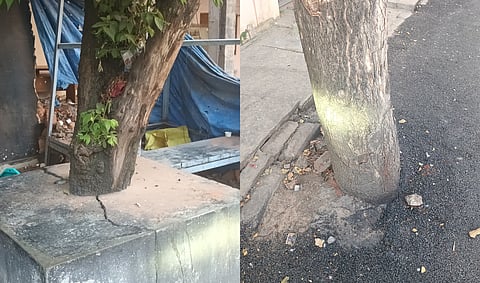

BENGALURU: Six months after the state forest department’s directive, the Greater Bengaluru Authority (GBA) has failed to remove concrete and cement blocks deposited at the roots of large trees on footpaths. This is choking the trees and leaves no space for them to grow, besides reducing the capacity for absorption of water.
An order was passed in June 2025 by the forest department following the directive from National Green Tribunal that concrete or blocks installed in one metre radius of trees should be removed.
Vijay Nishanth, popularly known as tree doctor, said, “There are around two lakh trees on the footpaths of Bengaluru including the old ones and the newly planted saplings by the forest department.
However, the cement blocks and concrete have been choking these trees, not allowing them to grow. When roads and footpaths are being constructed, the GBA has to direct the contractors to leave enough space around the trees so that the soil around the trees will absorb water and nurture the trees.”
He added, “After complaining about this issue, Eshwar Khandre, Minister for Forest and Environment, came and helped in removing the cement blocks, made space and added soil around some of these trees in the city. After that GBA had to do it consistently, however, they have failed to do it.”
When the TNIE contacted, M Maheshwar Rao, GBA Chief Commissioner, said, “When GBA was formerly BBMP, we had begun the deconcretisation around the trees. After forming multiple corporations, the onus is on individual corporations and they have been instructed to follow the order of deconcretisation around the trees.”
Meanwhile, Benson Issac, who is into environmental consulting, highlighted the need to preserve avenue trees in the city. He said, “Bengaluru houses all types of trees which are indigenous, exotic and those that flower during a particular season.
The city has avenue trees that are over 500 years old and we need to preserve them. Concretisation of footpaths and white topping has left no space for tree trunks to grow at all. Trees must be treated as an integral part of the infrastructure when they design the footpath and create space for utilities. These designs must be also planned keeping in focus the kind of trees grown in a particular street.”
Bengaluru has Jackfruit trees, Neem, Red Silk Cotton, Banyan trees, Sausage tree, Ashwatha tree, Honge, Kadamba and Jamun
Types of avenue trees in Bengaluru: Gulmohar, Raintree, Badminton ball, African tulip, Tabebuia flowering trees and Copper Pod
