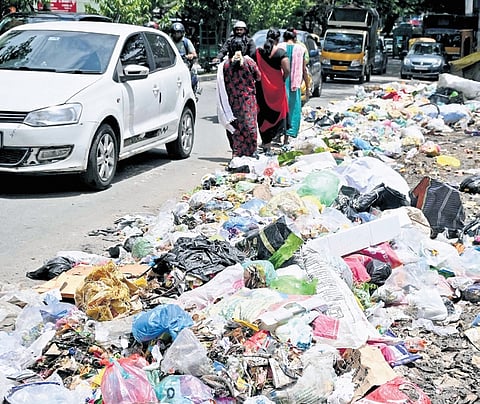

BENGALURU: A study by a team of researchers and mobility experts at Indian Institute of Science (IISc) has claimed that Bengaluru offers good standard of living, but poor quality of life.
In the report, “1st World Symposium on Sustainable Transport and Livability,” they compared Bengaluru’s infrastructure, travel distance and modes of transport to other global cities and listed the lessons to be learnt.
Ashish Verma, Professor, Transportation Systems Engineering, Convenor, IISc Sustainable Transportation Lab, said, there is a difference between quality of life and standard of living. The latter indicates the purchasing ability like to buy a car, while the former is a reaction to the time one takes to reach workplace or any other destination. The stress one undergoes, the time spent in traffic jams, health impact and economic factors.
The report said the city lacks infrastructure for people to walk or cycle to keep good health, hence impacting quality of life.
Verma added: “Government officials and experts visit many international cities, including Singapore to find the best mobility solutions, but the best practices are not followed. Singapore’s tunnel road project, which Karnataka government is promoting, is an example of that.
The average annual per capita income of people in Singapore is around $84,000, while that of people in Bengaluru is $3,000. In Singapore the government has capped car growth to 120 cars per 1,000 population, but in Bengaluru it is over 165 cars per 1,000 population, which is rising every day.”
Verma in the report pointed to the need for a dedicated service cadre on urban and transport systems which is critical to bridge the skill and technical knowledge gap in mobility and traffic management.
He also pointed to the need for the Ministry of Housing and Urban Affairs to take the lead in developing guidelines for effective urban transport systems and not the Indian Road Congress, which provides standards for road and infrastructure design.
The report highlighted six transport themes that the government needs to focus upon- well being; health and happiness; livability/quality of life; equity and accessibility; environmental quality and disaster resilience; and other transport aspects related to livability and quality of life. Each explores critical intersections between transport, well-being, equity and health.
The report pointed to the need for creating livable cities with improved quality of life through sustainable transport solutions. It stated that there is a need for investigating how sustainable transport interventions affect livability and quality of life, spatial analyses of urban accessibility, street design and walkable streets.
It also pointed to the need to address how sustainable transport impacts safety, affordability, equity and accessibility. It stressed on the need to ensure social inclusiveness, particularly the marginalised communities, to promote social justice and bridge the existing disparities.
