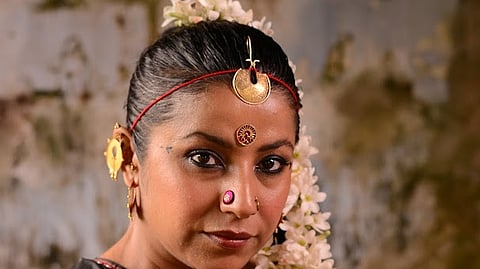

What’s your memory of seeing a bindi? Maybe it was when you were nestled in your mother’s arms, eyes drawn to that tiny figure resting between her brows. If your home pulsed with music, you might recall singer Usha Uthup, her deep voice, bold sarees and that statement bindi that refused to be overlooked. Or perhaps, it was Komolika (played by Urvashi Dholakia) from Kasautii Zindagii Kay, her bindi as dramatic as every move she made on screen.
Somewhere between nostalgia and reinvention lies Meghna Khanna’s story, one where the bindi steps out of memory and into modern identity. With celebrities like Kareena Kapoor Khan, Kajol, Janhvi Kapoor, Tamannaah Bhatia, Usha Uthup, Sonam Kapoor, and more, wearing her designs, The Bindi Project has carved a space for itself in designer fashion. Her ‘moment of arrival’ came when Kareena wore one of her bindis, a piece made from a scrap of leather that “looked like a million bucks” on her. “I was driving to my farm outside Bengaluru when my inbox just exploded. I cried all the way there. If it was relief, it was joy. It felt like validation for all those years of swimming against the tide.”

Khanna’s thoughts move easily between laughter and reflection as she describes how a single dot grew into an entire movement. A Bengaluru-based entrepreneur, she started the brand guided by curiosity and a sense of purpose. “I always think of myself as an inconvenient person. Even as a kid, I was called ‘too much’. But I was always swimming upstream. Always fighting for more, for what I wanted.”
Her journey to The Bindi Project began after she closed her long-running store, Levitate, during the pandemic. “I had run Levitate for 18 years. After closing it, I wanted to create something meaningful. One day, I found my old leather tools, and a conversation about heirloom gold bindis sparked an idea. I started researching the history of bindis and realised that the sticker versions we use today only came around in the ’80s and were not sustainable,” Khanna shares.
That discovery became her new design brief. “I wanted to make reusable bindis with certified skin-safe adhesive, created from upcycled materials. We’re taking the craft to couture. They’re luxurious, beautifully handmade, but created with zero waste.” She adds, “I tell my clients: don’t stick them on mirrors, like your moms did! Put them back in the packet and they will last forever. They’re like jewellery.”
For Khanna, the bindi is an act of reclamation. “It’s a form of acceptance of our inner goddess. So many of us grew up being told not to be too visible, too loud, too expressive. The bindis we create are for the ‘too much woman’, the one who’s unafraid to express herself, to claim space, to be seen. I used to think I’d change the world overnight. Now, I do it one starter pack at a time,” she laughs.
She remembers the early days of Levitate, her first venture, when she began selling bold, oversized nose pins at a time when no one else did. “Women would look in the mirror and say, ‘My husband won’t like it, my mother-in-law won’t let me in the house’,but very few said, ‘I love it’. Getting women to see their own beauty is the challenge and the reward,” she says.
The recognition, she says, isn’t just hers, it belongs to the women who craft each piece with care. Many of them are single mothers who can now afford to send their children to school, women who once doubted their abilities but now come to her brimming with ideas. She now gets orders from all over the globe.
Looking ahead, she plans to collaborate with artisans across India to develop fresh designs rooted in traditional art forms. “If Korean fashion and Scandinavian homes can be a thing, then bindis are going to be the next big thing. I’m bringing the bindi back,” she says, oozing confidence.
You can buy The Bindi Project’s reusable handcrafted bindis (pack starting at Rs 1,000) at www.thebindiproject.in or on Instagram at @the_bindi_project