
Fuzzy guitar and mandolin twangs lull you into the ’80s as actor Upendra’s lines sparks a snap of recognition, radio-esque sounds add to the atmosphere, while classical music ragas and the bold notes of a nandaswaram player’s trumpet round out the music of the Bangalore Sonic Archives. What’s left at the end of listening to this 7-track album is the feeling that one has just swallowed all the familiar sounds of the city in a capsule.
“It’s like an audio itinerary,” says Joel Sakkari, the musician who goes by the moniker Sakré and is the force behind this immersive beat album. He adds, “There are a lot of special places in Bengaluru. What I wanted was to incorporate my sound (sampling and soundscaping of South Indian cinema) and create a background score for these spaces. I believe that film music has been the background score of everybody’s life. Whether or not you actively listen to these film songs, you hear them in autos, restaurants and everywhere in the city.”
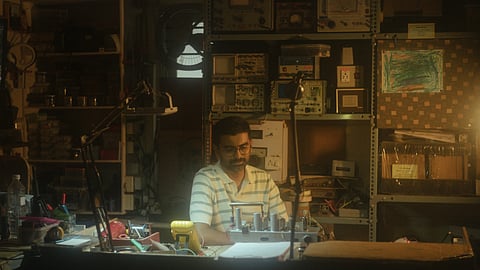
The album started off as a week-long social media project for a Dubai-based gallery, and Sakré aimed to showcase a piece of Bengaluru through short pieces of his music set to videos of him playing these tracks at recognisable but not tourist-occupied places in the city – Indian Coffee House, the Big Banyan Tree and Shortwave Radio Museum, to name a few. The tracks Gangubai and Gangubai Hangal Shashtriya Sangeeta, a collab with Babloo Babylon, are a tribute to the iconic classical musician and Sakré’s roots in Dharwad.
While you hear snatches of film dialogues, sometimes cheeky and ironic, throughout the album, particularly in Baa Illi and Chandni, one of the sampled sounds that stand out is the mysterious radio recordings.
“I learnt about this from Uday Kalburgi, who runs the shortwave radio museum. There are a lot of strange things that happen when you keep browsing on shortwave radio stations, which emits signals that sound like synthesizer musical notes. So I took some of those frequencies, sampled them and made a track out of it. The voices that you hear in the track 4265 kHz are from a particular station called 4265kHz. That station has been mysteriously emitting only beep signals every second since the late ’70s, but every now and then, there’s a man who says some letters, like a cryptic message to whoever is tuned in.”
The musician is known for tracks that have a distinctly nostalgic air about them, and this, he says, is not just because of the old film songs and dialogues he picks, but the constraints of working on his instrument of choice.
“Today, conventional music production happens on digital audio workstations, which are like workhorses that have so many options and sounds. But my workflow tries to mimic the workflow of the ’80s, when they had a small tape machine with four tracks, and people tried to be creative within that. I use analogue instruments like the Roland SP-404,” he explains.
To get around restrictions on different platforms, he recreates the music on his guitar for some tracks, instead of sampling the original songs. “Sampling is a legitimate art form like multi-media art where you take something, chop it, and reinterpret it. But since different platforms have different (copyright) regulations, I’ve tried to figure out the way the songs have been recorded and play those guitar parts by myself. You barely hear any difference, but it is there,” he says.
