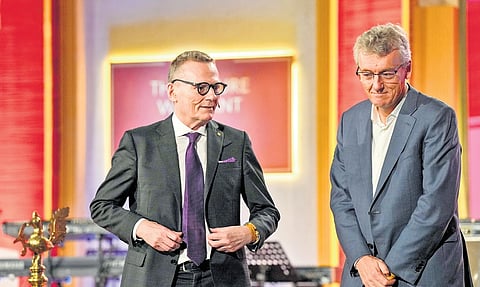

BENGALURU: Nobel laureates James Robinson (Economic Sciences, 2024) and David MacMillan (Chemistry, 2021) delivered lectures on Monday at Nobel Prize Dialogue Bengaluru, an event that brought together the two and other experts to discuss possible ways to achieve a more sustainable and equitable future.
The event was organised by Nobel Prize Outreach in collaboration with Tata Trusts, and held at the Indian Institute of Science (IISc). Robinson was the first to speak; he sought to dismantle any purported hierarchy of the West, which he said preserves the illusion of a “one-way street” to development.
Instead, he argued that development should be subjected to multi-way junctions, where nations can learn from each other.
MacMillan walked the audience through organocatalysis, a term he coined for the usage of organic elements for catalysis: the innovation that won him the Nobel Prize. Unlike metals, the usual components for a catalytic reaction, organocatalysts are naturally abundant and renewable.
“We’re one catalytic reaction away from solving climate change. We have to do a better job of explaining to the world how important these types of scientific areas are – because we really are that close,” he said.
Also present at the discussion was Indian economist Montek Singh Ahluwalia, who participated in a panel about sustainable urban development. “Citizens of Bengaluru or of any city in India (unfortunately) do not exist in a system that elects a mayor for the city who is in complete (and sovereign) charge of the city,” he rued, adding that hope for a better world must be rooted in science and knowledge, rather than the exclusionary ideology that is on the rise in the US.
Tata Trusts CEO Siddharth Sharma added, “India’s greatest wealth lies not just in its natural resources, but in the power of its people and their capacity to learn. We are well on our way to being the third largest economy in the world. The future envisages justice – social, economic, and political. To achieve this, we must empower the youth and create ecosystems fuelling innovation for the people who need it the most.”
