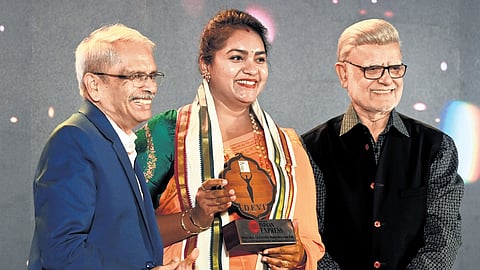

BENGALURU: Infosys co-founder Kris Gopalakrishnan on Saturday said while AI and advanced technology will reshape the future of work, progress must be anchored in empathy and inclusive growth — and women leaders are better positioned to sense that need.
Speaking at an interaction during the 35th edition of Devi Awards 2025, he stressed that AI is “only a tool”, and that progress happens when “humans-plus-technology” work together. He added that innovation must not exist “for research’s sake”, but result in tangible societal benefit.
“AI will lead to job losses, we can’t avoid that. But we can ensure humane transition: retraining, giving people time to find alternative jobs, creating social safety nets. Women leaders probably sense that better than men,” he said, adding that India does not need to copy the West. He emphasised that any new model must be rooted in India’s value systems and affordability realities.
Citing a study conducted on AI subscription costs, he contrasted ChatGPT’s global subscription of $20 a month, with what is viable in India. “We concluded that Rs 50 per month is affordable in the Indian context. With our scale, even that price-point makes economic sense,” he said.
Addressing women’s participation in the workforce, he highlighted that a significant portion of women’s work, especially in informal sectors, remains invisible and unpaid. He said work must be recognised, measured and compensated.
He reiterated the urgency for India to own the technologies of the future. “Everything we use today — from brands to technology — is foreign. We can’t become a developed nation if we don’t own our science and technology innovation,” he said. India must chase emerging frontiers — not spaces where the world is already ahead — such as 2D materials, product computing, and energy-efficient AI.

Among the areas where India has taken the lead is brain science. Gopalakrishnan, who funds advanced research at IIT-Madras and the IISc, explained that their brain centre has become a global first-mover. It obtains cadaver brain donations across all ages, slices the brain into 50-micron layers and digitises images at one-micron resolution.
“For the first time, an entire human brain has been imaged at cellular level and reconstructed in 3D,” he said. While the world has only completed 15 such brains, IIT-Madras has already processed over 70 and is moving towards 200. The research will deepen understanding of brain development, disease progression, physical differences between male and female brains, help surgeons prepare for complex cases, and improve MRI technologies.
He added that the human brain remains active even after death. “You can stop the heart and replace it, but you cannot stop the brain,” he mentioned.
Gopalakrishnan also spoke about ageing and dementia, warning that India is likely to see 50 million people afflicted by Alzheimer’s or related disorders within 30 years.
“We still have no cure. That’s why research is necessary,” he said. He has helped create a nationwide membership-based senior citizens organisation that offers services free of cost, partners with innovators working on solutions for the elderly, and lobbies for policy change. One recent outcome, he said, is that the Centre now allows standalone health insurance for people over 70.
On women in sports, Gopalakrishnan said India’s victory on the global stage will propel women’s cricket and inspire more women to pursue sports careers. “For the first time, the price tags are increasing dramatically. We want India’s women to shine in every field.”
He concluded by underlining the need to preserve India’s distinctive strengths — including its heritage of handicrafts and bespoke artisanal work. “Slight imperfections add value. If everything becomes perfect and standardised, we lose uniqueness,” he said.
DEVI AWARDS
Were presented to the following achievers
Veda Krishnamurthy, former cricketer and broadcaster, for her contribution to the sport
Sahar Mansoor, founder of Bare Neces-sities, for helping people live a zero-waste life
Shraddha Srinath, multilingual actor, for excellence in entertainment
Pragati Mathur, textile artist and handloom innovator, for weaving absolute magic
Anita Nair, acclaimed author, for her brilliant writing across genres
Mayura Balasubramanian, founder of Craftizen Foundation, for making craft a tool for empowerment
Deepthi Bopaiah, sports administrator, for driving systemic change in sports
Hema Ravichander, management professional, for management of crises
Divya Raghavendra Rao, co-founder of The Rameshwaram Café, for her visionary role in bringing authentic and hygienic food while transforming a humble idea into one of India’s most celebrated food brands
Chayaa Nanjappa, social entrepreneur and founder of Nectar Fresh