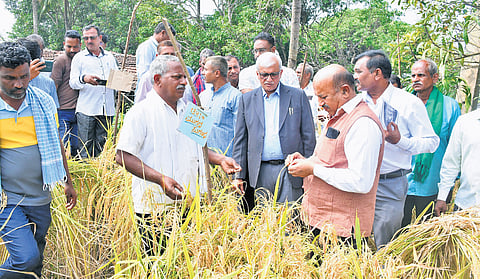

BELAGAVI: A silent revolution is on to preserve desi paddy varieties in a little-known village of Gundenatti in Belagavi district.
Shankar Hanumant Langati, a small farmer from this sleepy village, is now a proud custodian of over 260 varieties of paddy that were on the brink of extinction.
Shankar, who was forced to discontinue studies after Class 3 because of poverty, never thought that his hobby of collecting traditionally grown paddy varieties and preserving them for posterity would bring him name and fame one day.
He lost his father when he was 14 and was left to fend for himself although he inherited three acres of ancestral land. With no help forthcoming, Shankar started grazing cattle in the village and earned Rs 300 a month. He then started working as a farm labourer harvesting sugarcane, paddy and other crops. In 2003, Shankar attended a seed mela organised by Shree Kshetra Dharmasthala Rural Development Project (SKDRDP) and the GREEN Foundation on the advice of Shaarada Dabhade, an activist promoting women’s empowerment in rural areas.
At the mela, he came across 25 native varieties of paddy that were once popular, but had been ignored by farmers who shifted to high-yielding hybrids. He brought those paddy varieties home and sowed them on his land. Using traditional farming methods, he reaped a good harvest.
Encouraged by this, he set out on a mission -- to find, grow, and preserve India’s lost paddy varieties under the guidance of Shivaraj Hunagund of Dharwad and Krishna Prasad of ‘Save Seeds’.

He visited Belagavi and Dharward districts and parts of Goa to collect native seeds. His mission took him to other rice-growing states such as Odisha, Manipur, Maharashtra, Tamil Nadu, and Andhra Pradesh. In recognition of Shankar’s efforts, the University of Agricultural Sciences, Dharwad, gave him 50 native paddy varieties.
Shankar embraced traditional farming methods, rejecting chemical pesticides and fertilisers. He also cultivates other seasonal crops. His crop calendar is diverse -- paddy during monsoon, and pulses, vegetables, chickpeas and sunhemp post-monsoon.
Marketing strategy
Shankar has a trusted customer base for his produce. On the outskirts of Gundenatti, he has constructed a store-cum-warehouse from where farmers and customers buy his products directly. He also goes to Dharwad’s Gandhi Shanti Pratishthan every Thursday to sell rice, pulses and vegetables.
A few years ago, Shankar bought nine more acres of land adjacent to his farm, where he has taken up dairy and fish farming besides cultivating paddy and other crops.
Apart from over 260 varieties of rice, his seed bank has coloured chickpeas (green, red, black and white) and red wheat and traditional millets that were on the verge of extinction.
Awards & recognition
Shankar has visited many countries to study sustainable agriculture and market conditions there. He mentors progressive farmers and farm university students. Scientists too visit his farm to study his cultivation methods. His efforts have earned him awards and recognition from well-known institutions.
He has been honoured with the Plant Genome Saviour Award (Government of India, Rs 10 lakh); district and state-level Best Farmer Award; recognition from Art of Living, Dharmasthala Foundation and Karnataka Biodiversity Board; Rice Innovation Farmer Award from ICAR, Hyderabad; and honorary doctorate from Dharwad university. His indigenous paddy varieties have been registered with ICAR. Recently, Shankar released a red rice variety, ‘Surendrasali’, which is considered ideal for diabetics.
With the help of his two sons, Shankar is now expanding his agri-business and has taken 50 acres on contract in Khanapur taluk. Narrating their early days of struggle, Shankar’s wife Mahadevi said, “We worked as labourers and grazed cattle. My husband has set up a successful agri-business from the scratch. Now, we are reaping the fruits of our labour.”