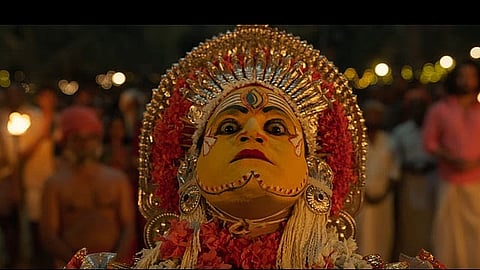

With actor Rishab Shetty’s captivating depiction of the bhoota aradhane or daivaradhane tradition in Kantara, the spirit worship practice has catapulted to mainstream attention all over the state. With the release of the film’s sequel, Kantara A Legend: Chapter 1, the fascination over the folk tradition reached new levels, with videos showing fans impersonating the ‘spirit avatar’. Following this, the makers requested the audience not to indulge in impersonations out of respect for the centuries-old tradition, which is significant to communities in Tulu Nadu.
Kannada Development Authority chairman and researcher Purushothama Bilimale points to the 14th and 15th centuries as the origin of the daiva aradhane tradition.
“This is the time when the agrarian sector took over from shifting agriculture and the concept of private land ownership emerged in coastal Karnataka. During that time, forest-dwelling communities lost land ownership and it was occupied by Jain agriculturists,” says Bilimale, pointing out that while the first movie dealt with similar themes of land and caste conflict, the sequel is ‘historically inaccurate’.
“There is no relationship between the history of the Kadambas who ruled in the fourth and fifth centuries and bhootas.” This shift resulted in a social conflict that is often reflected in the origin stories of deities recorded in ‘pardanas’ or oral epics told through singing. “Some deities like Panjurli (the boar deity in Kantara) are animistic, but a major category are human deities, who led a life of fighting against injustice and died an untimely death, attaining deity status,” explains former vice-chancellor of Karnataka Folklore University K Chinnappa Gowda. The deities then go on to take revenge on wrong-doers or protect their devotees.
Bilimale elaborates, saying, “Most of the bhootas hail from the lower strata of society. For example, there is a deity called Kalkuda Kallurti, who is part of the community of sculptors. The story goes that he was asked to build a gommata by the King, but the latter told his servants to cut off the sculptor’s right hand and left leg so he could not build any other gommatas. He dies by suicide and becomes a daiva.”
Researcher Chithra Kallur adds, “There are around 500 different bhootas or daivas documented so far but there may be many smaller spirit deities that likely haven’t been documented yet. These daivas are also divided into hierarchies and different communities like the pambadas, paravas and nalikes impersonate different deities.”
Despite the deeply spiritual nature of the kola, it is an open-door practice where respectful visitors who want to experience them are welcome. “On the day of the kola, the entire village gathers. As an outsider and researcher, I have benefited from being an outsider, who are the first to be called upon by the daiva and blessed when addressing the devotees,” he says. But how does one attend a kola if they happen to find themselves in the Tulu region? Kallur says, “The season for kola starts after Deepavali and goes on till May. Each ‘sthana’ has a fixed time of the year when kolas are organised. In December, you’re bound to find banners announcing a kola or nema in Mangaluru.”

Unlike folk theatre and dance forms like Yakshagana, Dollu Kunitha or Veeragase that periodically see performances in the city, this has not been the case with Bhoota Kola due to the spiritual nature of the practice, where the performer is possessed by the deity. This seems to be at the core of why fans of the film impersonating it have upset believers of the tradition. Kallur says, “You have to perform it on a specific day and there’s a ritualistic process of impersonating the deity. It involves putting on makeup, paraphernalia, the family singing the diety’s pardana and finally, the mask being handed over to the performer. There’s also a systematic process of the deity leaving the body. It is a ritual that is at the core of the belief system of Tulu culture.”
Apart from the music, dance and storytelling serving as an outlet for the community’s frustrations, at the core of the kola is also the deity’s conversation with devotees.
“The oracle speaks fearlessly. It could be problems of the community or the family – the bhoota delivers justice and this tradition acts as a folk judicial system,” explains Gowda. Bilimale adds, “Temporarily, people of the ‘lower caste’ become deities and have complete control over society. But after the performance, they go back to working under the zamindar. It’s an outlet for anger, but afterwards, things go on as usual.”