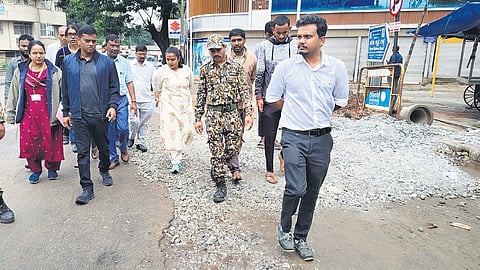

BENGALURU: Potholes and bad stretches of roads that have ruined the image of the IT capital is nothing but a reflection of lack of coordination among civic agencies like BWSSB, BESCOM, and KPTCL, as these agencies have failed to restore the municipal corporation roads after their work.
To address the problems created due to lack of coordination, Bengaluru Central City Corporation Commissioner Rajendra Cholan has issued instructions to halt all ongoing road excavation works and to deny permission for any new road-cutting activities by any agency within the corporation limits.
“This directive applies to all departments, including BWSSB, BESCOM, and KPTCL,” said Cholan. He also has announced nodal officers for each road under the Corporation’s limits to monitor and resolve issues such as potholes, black spots, waterlogging points, streetlight repairs, and pedestrian pathway maintenance. A list of nodal officers is already available, and issues will be resolved in a phased manner.
During the inspection of various areas on Thursday, the Commissioner noted that although departments such as BWSSB, BESCOM, and KPTCL have completed their respective works, they have failed to properly restore the roads after excavation.
As a result, instructions were given that no new road-cutting permissions be granted and that all current projects be suspended until the previously excavated roads are fully restored by the respective agencies. It has been observed that even after the Corporation develops or repairs roads, other departments undertake works by cutting through them and then neglect to restore the roads to their original condition.
This not only tarnishes the reputation of the city but also causes significant inconvenience to vehicular traffic. The Commissioner emphasized that such negligence cannot be tolerated.
He has directed that a detailed, ward-wise list with photographs of all roads excavated by BWSSB, BESCOM, KPTCL, and other agencies be compiled.
This list should then be used to call meetings with the departments concerned and ensure that road restoration and pothole-filling works are taken up without delay. Only after proper restoration is verified will permissions be granted for ongoing or new projects.
During inspection of key roads such as Sampige Road, Sheshadri Road, and areas around Shivananda Circle, the Commissioner instructed restoration of road surfaces and pothole-filling.
Instructions were given to identify and list all Corporation-owned properties and to take steps for their proper upkeep and protection.
NEW GBA UNIT TO COMPLETE WORLD BANK-FUNDED WATER PROJECT
After cessation of the Bruhat Bengaluru Mahanagara Palike (BBMP), paving the way for the Greater Bengaluru Authority (GBA), the Karnataka Government has passed a resolution that the
Rs 2,000-crore World Bank-funded Bengaluru Water Resilience Project will be moved from the Storm Water Drain (SWD) Department of the erstwhile BBMP to the ‘Project Implementation Unit’ (PIU) of the GBA, and the works will be taken up under 16 packages. SV Rajesh has been appointed as Chief Engineer of the PIU, and some of the 10 executive engineers working under the GBA Chief Commissioner, will be moved to PIU.
Henceforth, the engineers working on SWD works for the implementation of a World Bank-funded project will have to report to the GBA Chief Commissioner, Special Commissioner (Finance), and Chief Engineer of the unit. According to officials, the loan will be disbursed from 2026 to 2031 in a stage-wise manner.
The project is to ensure that Bengaluru becomes climate-resilient, floods are managed well by increasing the retaining walls of SWDs (173 km) and enhancing lakes, particularly in peripheral areas. The fund will also be used for the Koramangala-Challaghatta (KC) valley that gets connected to the Pennar river.
