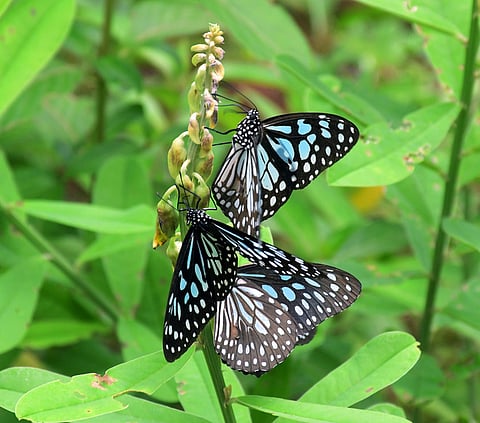

BENGALURU: Just like large mammals and other wildlife, butterflies also migrate — but now, they are moving towards safer habitats due to increasing urbanisation and climate change.
Experts have noted increasing deaths during their migration in many places. Noted lepidopterist and Associate Professor and Principal Investigator, National Centre for Biological Sciences (NCBS), Krushnamegh Kunte said many Lemon Emigrant butterflies have been sighted lying dead on Ballari Road, due to increased movement of high-speed vehicles and construction activities. This is one of the threats butterflies are now facing, apart from unprecedented rainfall, he said.
Thus, experts and observers, including lepidopterists, researchers, educationists, academicians, retired defence personnel, students and homemakers have urged people to protect lung spaces, and home/kitchen/balcony gardens, parks and playgrounds for these pollinators.
Studies show that during the southwest monsoon, butterflies migrate from Western Ghats to the Eastern Ghats and during the northeast monsoon, they travel back. Four large species have been studied — Tirumala septentrionis (Dark Blue Tiger), Tirumala limniace (Blue Tiger), Euploea core (Common Crow) and Euploea sylvester (Double-branded Crow) — to understand long-range migration of other species along with the migratory pattern, said Rohit Girotra, founder member of Bengaluru Butterfly Club.
Experts are also studying the decline in species in Karnataka, particularly in urban areas. “Bengaluru houses a large number of butterfly species, compared to other metropolises. So far, 180 species have been documented in Bengaluru, though there is no clarity on the number. In the past 15 years, 40 species were added to the list, including the Graphium nomius (Spot swordtail). There is a need to protect butterflies because of unprecedented rainfall, and also unplanned urbanisation,” Girotra added.
Butterflies are the second largest pollinators after honeybees. Awareness on their protection, especially on city outskirts like Hessarghatta, Makalidurga, Savandurga, Devarayanadurga and surrounding areas, is needed where development is gaining momentum, experts pointed out.
They noted that butterflies are also found to adapt to changing environmental conditions and surroundings while finding new home ranges. An increase in Elymnias caudata (Tailed Palmfly) has been noted because of the large presence of palm trees.
Also an increase in Gangara thyrsis (Giant Redeyes) and Troides minos (Southern Birdwing- Karnataka’s state butterfly) has been noted. It has also been observed that they are adapting to changing agricultural practices. Experts pointed to a decline in the sighting of some species, like Cigaritis lilacinus (Lilac Silverline).
Kunte said in the past few years, they have recorded some rare species like Bibasis sena (Orange-tailed Awl), Caprona alida (Alida Angle), Tarucus balkanicus (Little Tiger), Papilio paris (Paris Peacock) and Rathinda amor (Monkey Puzzle).
