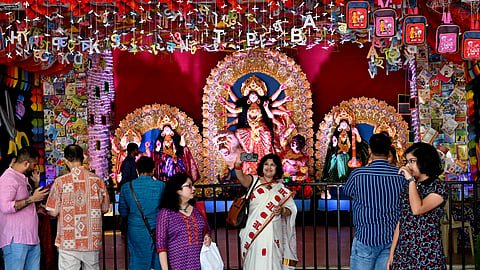

A distinct rhythm and energy take over the city during Dasara, when the Bengali community ushers in the Durga Pujo festivities. Slowly yet steadily, the metropolis transforms into a vibrant canvas blending art, culture and devotion, all mirroring the festival spirit of Kolkata. As the smell of dhuno dhoop lingers in the air and dhaak beats (traditional rhythms played on the Dhak – a barrel shaped drum, signifying the start of the festival in Bengal) echo across pandals, Durga Pujo in the city this year shapes up to be a homage to Bengal’s rich culture and community.
For communication professional Karan Sharma, the pujo is a true-blue emotion. “Pandal hopping has always been a personal ritual,” he says, recalling nights lit with fairy lights and the warmth of home. He finds solace in pandals spread across Ulsoor, Whitefield and Koramangala, where ‘cultural performances and food stalls make the city feel like a mini-Bengal.’

Far from home and hit by nostalgia, for many, the festival evokes a sense of homecoming. Account executive Ankita Purkayastha’s memories, which she holds close to her heart, are steeped in family traditions, from offering anjali on Ashtami to pandal hopping with her father on his scooty. Though she misses the grand family feasts and childhood friends back home, she finds comfort in the familiar beats of the dhaak at local pandals. “The sound of the dhaak is the heartbeat of the Pujo,” she highlights.
Akin to the previous years, this time, Bengaluru’s pandals are not just venues for prayers but spaces of cultural expression. The Bongodhara Cultural Association is all geared up with its ‘Gram Bangla’ theme this year – a deeply evocative tribute to rural Bengal. Set against an earthy backdrop of mud walls, alpona (motifs made with rice paste) and a traditional ek chala durga idol, the pandal transports visitors to a Bengal of simplicity and togetherness. “The idea behind Gram Bangla is to honour the roots of Durga Pujo in rural Bengal. We want people to experience the warmth, simplicity and togetherness that define celebrations in villages, without losing the devotion and happiness that the festival embodies,” says Aparajta Ray, a representative of Bongodhara Cultural Association.
Yet the city’s cosmopolitan nature adds another layer to the celebrations, says Sharma, highlighting Bengaluru’s diverse culture. “Being away from Bengal, I miss the grandeur and the familiar faces back home. But Bengaluru makes up for it in its own way as the city is full of beautifully decorated pandals, complete with cultural performances and, of course, food stalls serving everything from Bengali classics to local delicacies,” he says.
What binds them all, whether native Bengali or honorary, is the food. Dishes like kosha mangsho, fish fry, mishti doi and luchi-ghugni are must-haves. “It’s when Maa Durga, the daughter of the family, returns to her parents’ home, and so, we too celebrate the occasion of abundance. From dum aloo, ilish mach to mutton biriyani and festival essentials like roshogolla, every dish is a part of the feast. It’s not just about eating but about sharing meals with your loved ones, reliving recipes passed down through generations and creating memories,” Purkayastha explains.