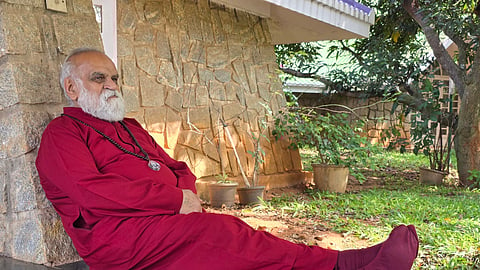

Even as new-age spirituality picked up steam around the world in the late 1960s, with the West becoming fascinated by eastern spiritual practices, including Indian ones like yoga and meditation, 20-year-old college student Swami Chaitanya Keerti did not care much for it. “I always avoided the spirituality column, thinking there would be some nonsense there, but one day , I thought I might be becoming prejudiced against religion and decided to read everything. That was the day Osho had written a piece – ‘Is man a machine?’, which talked about how we function like machines, becoming happy when someone says nice things and sad when it is bad and how the remote control remains in others’ hands. his point was that meditators would respond, not react,” he recalls.
That piece took him down the path of ‘neo sanyas’ shaping up around Osho, dropping out of college, and taking sanyas in 1971, when the guru was operating out of a Bombay apartment. What he remembers is a magnetism: “My first meeting with him, I was alone and I could not look into his eyes because there was so much radiance. he asked me ‘What brought you here?’ It took me a while to answer that, but I said, ‘I want to be with you’. Sometimes, I would write things down before meeting him, because when I looked into his eyes, I would forget.”
55 years later, he is still on that journey , teaching dynamic meditation, a cathartic meditation process popularised by Osho, most recently at The School of Ancient Wisdom in Devanahalli, organised by Friends of Osho. he explains, “Osho felt that people suppress so much, unless they detox, meditation cannot happen. So you have to get rid of it with catharsis.” The steps involve breathing vigorously , releasing pent-up emotion through open expression, followed by a phase of yelling ‘hoo’ to activate the root chakra. The last two steps, 15 minutes each, involve freezing in position and expressing joy.
When it comes to Osho, fresh in popular memory are two documentaries about the guru’s infamous disciple Ma Anand Sheela’s return to India, 'Searching for Sheela' (2021) and 'Wild Wild Country' (2018). The latter investigated Ma Anand’s involvement in a mass salmonella poisoning case in Wasco County , Oregon, where the guru’s ‘Rajneesh-puram’ ashram was, the duo’s arrest and more. Among those who lived through the time, Keerti says he ‘loved the documentary because it took Osho’s name all over the world,’ adding, “There were many people against us at the time (in the US), but Osho never bothered about the negative.”
On the controversies that have followed Osho’s attitudes toward sexuality and spirituality Keerti says, “All Osho was saying is ‘do not suppress sexual energy , live it and transform it’. If you are fasting for two or three days, then all you think of is food. When you bring consciousness to it, then even a single experience can be a liberating one.”
