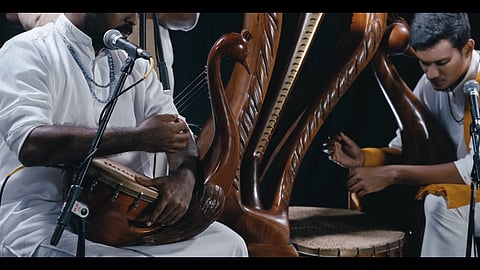

A 2,000-year-old instrument, carved out of wood into the elegant curve of the mythical yaazhi’s neck, animal skin covering the resonator and thin strings connecting them both, is the stuff of myth, legend and epic poetry, akin to Apollo’s lyre. The notes breathed by this ancient instrument, the yazh, described as ‘honey-like’ in Sangam poetry, once captivated the hearts and ears of ancient Tamilakam, spanning Tamil Nadu, Kerala, Puducherry, Lakshadweep and the southern parts of Andhra Pradesh and Karnataka. The instrument and the soundscapes it created were lost to the winds of change sometime in the last two millennia until ‘Uru Paanar’ – a small collective of musicians – embarked on a journey of reviving it and crafting an album of songs that breathe life into it. A performance film of their music, Thol Talkies, is set to be screened at Sabha, Kamaraj Road on January 9.
“The movie is all about our first album Thol, released in late September, and talks about the five ‘Tinais’ or landscapes of Tamilakam or South India described in ancient literature, particularly Tholkappiyam,” says Sivasubramanian Muthusamy, Uru Paanar’s co-founder. These landscapes include the mountains, coasts, fields, drylands and pastoral lands or forests, each associated with different emotions and the varied lives of people living in these regions. He adds, “The album and the film take you through these emotions, like time-travel.”
Reviving an instrument this old was no easy task for Luthier and Uru Paanar’s founder Tharun Sekar. He had been crafting his own guitars since his teenage years and in the midst of exploring making Indian instruments when Muthusamy approached him in 2019 with the idea to make a yazh. Recounting the challenges that faced the project he embarked on, he says,“Everyone in Tamil Nadu has heard about yazh at some point in time, but the instrument itself did not exist in a playable form anymore. There were not many sculptural depictions either.” To bridge the gap, they turned to Sangam literature, which often spoke of the instrument in metaphorical terms.
The first, the Sengotti Yazh, took Sekar a year to make, followed by the Paeri Yazh, Seeri Yazh, Kaivizhi Yazh, Sagoda Yazh and even a percussive instrument called Kudamuzha. Today, the eight-member collective performs around the world with the yazhs and other instruments, including a traditional flute and parai. “They all have different tonalities – variation in the number of strings gives range to each instrument,” Muthaswamy says.
While the sounds are rooted in the past, the group brings their own interpretations of the old to create something that connects with today’s youth. “We are all young musicians and designers coming together, so there is new writing with the old instruments and old soundscape that we are trying to create, almost like a re-interpretation of this literature,” he adds.
The film is both a way to document past sounds and tune them to the life of the present, which Sekar promises will be ‘a completely new experience’.
