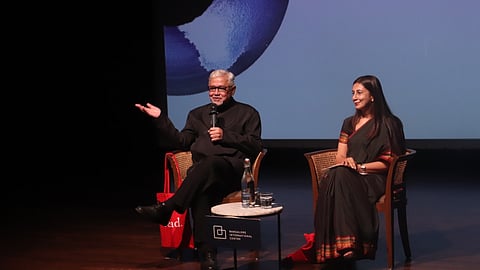

Just a year after his last book, Wild Fictions: Essays, came out, Jnanpith Award-winning author Amitav Ghosh has returned with what his fans have missed for the last few years: a novel. The Bengaluru launch of Ghost Eye was evidence of this, with the auditorium at Bangalore International Centre (BIC), Domlur on Friday, packed with those eager to hear Ghosh and writer Anjum Hasan, unpack the nitty-gritties of the book,which follows the story of a three-year-old Marwadi girl in 1960s Calcutta. Despite being raised in a strictly vegetarian household, she suddenly asks to be fed fish, remembering a past life spent in the Sundarbans. Simultaneously, readers follow her nephew in Brooklyn, in the midst of a pandemic, trying to understand the events of his aunt’s childhood better.
“I find the scholarship on reincarnation absolutely fascinating because there’s just so much of it – from India, Burma, the US, even in communities that don’t recognise the phenomenon. The moment one such case exists, it shows you that the world is not what the materialist, mechanistic worldview tells us…there is so much that we don’t know about,” he said.
When an audience member later pointed out that the author seems to be gravitating towards mysticism compared to his roots in historical fiction, Ghosh responded with a laugh, “But my book is not about mysticism, it’s about food!” Food, particularly people’s relationship with it and the environment that provides it, is a big part of the book as Ghosh had expanded upon earlier, saying, “How is the cook or the fisher woman thinking about the products of the land and what is the nature of their intimacy with those products, as opposed to the scientist’s? An ichthyologist, if they see a whole fish, might be able to tell you the difference [between two species], but they would not be able to by tasting them. I find that very interesting. How do we really distinguish between these forms of knowledge?”
Ghosh was recently in the news for being chosen by the Future Library Project, an initiative by artist Katie Paterson, which collects an original manuscript each year by a popular writer which will remain unread until the year 2114. Margaret Atwood, Ocean Vuong and Han Kang are among those who have contributed. “People say that in the modern world, we think in cycles of four or five years, corresponding to the electora lcycle, whereas our ancestors thought in terms of at least 100 years. [I wanted to know], what it would be like to think of one’s own work within that century'long time horizon? Now that I’ve been trying for the last four months, it’s incredibly difficult. The first inclination is to write something speculative, but the world will be so profoundly changed in 80 years that whatever you write will seem hilarious.You don’t want to make a fool of yourself in that way,” he said.
