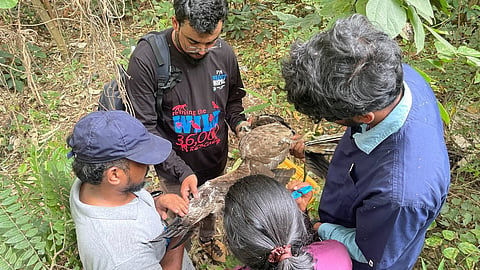

BENGALURU: With the festivities of Sankranti likely to kick in a few days, organisations that rescue birds hurt by manja thread are worried about more people using the thread to fly kites in and around Bengaluru.
In a shocking revelation, People for Animals (PFA) has received 40 manja-related rescue calls in the last ten days, indicating a sharp seasonal surge. In 2025, the organisation rescued 790 birds injured by manja thread, compared to 469 such cases in 2024.
Usually, black kites, house crows, pigeons, barn owls, jungle crows along with multiple cases of fruit bats, egrets, herons are the most affected species by the manja thread.
Colonel Dr Nawaz Sherif, Chief Veterinarian of PFA, said, "Our wildlife hospital has been able to successfully release a large number of manja-affected birds, primarily through Imping, a specialised feather-implantation technique. With imping, a recovery that once took months or even a year can now take just a few days, sometimes less than 24 hours. Over the past few years, more than 1,000 birds have regained their ability to fly and have been released back into the wild."
When asked if there were any deaths due to manja thread, he added, "Despite timely rescue, nearly one in ten birds injured by manja do not survive, highlighting how severe these injuries are. But what is even more concerning is the number of birds that end up in Lifetime Care (LTC), which are permanently disabled, especially when the sharp nylon thread partially amputates wings."
The biggest concern is the sale and use of Chinese Manja despite the ban by the state government a few years ago. Subiksha Venkatesh, Lead Wildlife Rehabilitator, said, "The problem with manja being sold in the market is it comes in a packet without a label on it. Whenever people go to the shops, the shopkeepers fix manja in the hoop to fly kites. However, when it is cut, it dangles in air, trees or buildings harming the flying birds. Manja has spread in a way that an aquatic bird, Great Cormorant, also became a target to the manja."
Only 33.5% people know about the ban
Meanwhile, Avian and Reptile Rehabilitation Centre (ARRC) in Bengaluru has conducted a survey in the community about the awareness of the ban of manja thread and 750 people were part of the survey. Interestingly, only 33.5% people are aware about the ban of thread and more than 66% are unaware.
Dr Ashrita Carlo, Senior wildlife veterinarian, said, "Over the past few months, rescues linked to kite string have increased sharply. In the last quarter alone, 1,560 birds were rescued, accounting for 43.16% of the total 3,614 manjha-related rescues in 2025. This year so far we have rescued 125 animals in just the past 7 days.We are currently rescuing over 20 manjha-related cases every day, while the actual number of distress calls may be 30 or more. The public concern in Bengaluru is real—our helplines reflect this daily."
She added, "Our team has been doing on ground monitoring in kite festivals and has been to collect 10 kg of manja threads from people in addition to creating awareness among them."
