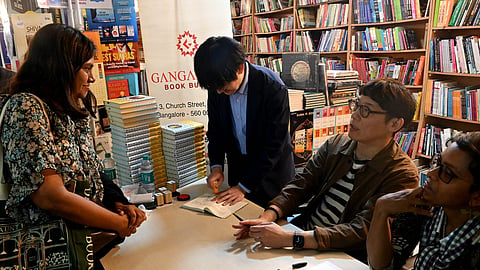

Over the last two days, the city’s readers have been buzzing with excitement at Japanese writer Satoshi Yagisawa’s visit to Bengaluru – his session with Shinie Antony on Tuesday sold out quickly and was packed with fans, while his four consecutive signings at Church Street’s bookstores yesterday were a similar sight with fans eagerly lining up to get their copies of Days at The Morisaki Bookshop signed. “My publishers had told me that my popularity has boomed in India, but since I’ve never been here, it hadn’t sunk in,” says the author.
Over 150 fans thronged his book signing in Chennai on Monday – one of his first events in the country. This success has been especially surprising for the author, given that the translation by Eric Ozawa, was released 13 years after the Japanese release in 2010. “When I was writing this book, I was an amateur author, and felt I would be lucky to be nominated for a prize and get a few readers. Even now, there are times I struggle to imagine myself as this popular author,” says the winner of the Chiyoda Literature Prize.
Amidst the rush, Yagisawa had the chance to talk to fans (albeit, through an interpreter), who often tell him of finding solace in his books during a rough patch. It’s this effect and the quality of Ozawa’s translation, he credits for the book’s global success, saying, “Ozawa’s translations are easy to read and respectful to your work. When he agreed to translate, I left it entirely to him.” The translation was shortlisted for the 2024 British Book Awards.
Yagisawa’s stories, Days at The Morisaki Bookshop, its sequel More Days at the Morisaki Bookshop, and recent release, Days at the Torunka Cafe, all have a slow-paced warmth to them, sending their lost, tired or heartbroken characters on an internal journey of self-discovery rather than a hero’s journey of conquest. Settings like the old bookshop in Tokyo’s Jimbocho or book district, become places of solace and means of forming genuine connections. This came from Yagisawa’s own deep love for Jimbocho’s bookstores, a stroll through the area becoming the seed of inspiration for Days at the Morisaki Bookshop. “I just thought – if there was a young lady living on the second floor of a bookshop, what would her life be like, what would her growth look like? Before that inspiration left me, I really wanted to write it down. I finished it in about a month.”
Since the success of the book, stores like the ones that nurtured him have been seeing a windfall as he says, “Some of my favourites were owned by elderly people who have since passed or closed their stores. But now, there are a lot of foreigners coming to Jimbocho, which is helping the place and I’m happy to see that.”
‘Comfort’ is a recurring word throughout our conversation as Yagisawa affirms that this is the feeling he consciously chooses to create with his books. “This is the kind of book I feel called to write,” he says. But the process itself is not as set in stone as this intention. “When I am taking readers on this journey, I am not steering the ship. It’s like flowing down a river. If I try to take it to a conclusion that is not following the natural course, the first people to feel that would be the readers, and the healing would be a lie. I am just the observer of the story – what I observe is what I write.”
Readers aside, is this process cathartic for him too? Yagisawa answers, “There are moments where I feel comforted too but most times, it is when I am reading the books later, after a year or two, and come across some good passages.”
