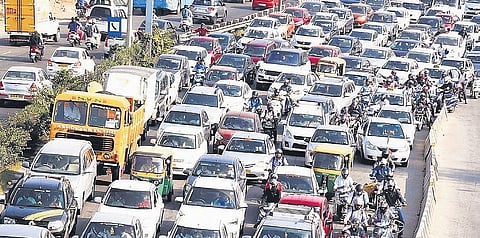

BENGALURU: Bengaluru has emerged as the second most congested city in the world in 2025, according to a study conducted by “location technology” firm TomTom. The Karnataka capital has a staggering average congestion score of 74.4% for the previous year.
The city follows closely on the heels of Mexico City in Mexico, which has a congestion score of 75.9% for the same period of time. Interestingly, however, its score has been on a downward trend, with congestion having reduced by 3.6% from 2024’s data; Bengaluru’s score however saw a hike of 1.7%.
Pune, which came fifth with a congestion score of 71.1%, is the only other Indian city in the top 10. As many as 492 cities across the world were studied, as per the report.
In 2025, during the morning rush hour, the average speed in Bengaluru was 14.6 km/h, and during the evening rush hour, it was 13.2 km/h.
A closer peek into Bengaluru’s mobility data for 2025 reveals interesting results. On an average, 4.2 km was driven in 15 minutes, which is 0.2 km less than the average distance covered in 2024.
For a drive of 10 km, the average time taken was 36 minutes and nine seconds, which was two minutes and four seconds more than the average time taken in 2024. Average speed during rush hour in 2025 was 13.9 km/h, which was 1 km/h slower than the average speed in 2024.
The city’s residents lost around 168 hours (around 7 days) stuck in traffic in 2025, which was a hike of 12 hours and 46 minutes from 2024.
The worst day to be on Bengaluru’s roads was May 17, a Saturday. At the peak hours around 6 pm, a meagre 2.5 km could be driven in 15 minutes.
Chennai and Hyderabad feature quite down the list, with figures much healthier than Bengaluru’s. Placed 32nd, Chennai received a congestion score of 58.6%, with a mere 0.1% uptick since 2024’s data.
At the 47th place, not only is Hyderabad’s congestion score significantly better than Bengaluru’s (55.5%), but also the much-discussed IT boom in the Telangana capital – much of which has been attributed to shifts from Bengaluru – has seemingly not affected mobility adversely at all. On the contrary, congestion decreased by 1.3% when compared to data collected in 2024.
