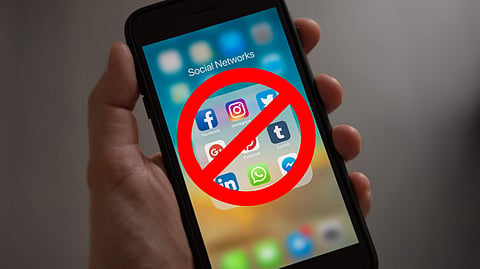

BENGALURU: While the government is yet to present a standard operating procedure (SOP) or roadmap to implement a ban of social media for children under 16 years, psychologists and psychiatrists from Nimhans have highlighted a few good practices from other countries on the use of social media by children instead of a complete ban.
The research paper -- Policies and Public Health Initiatives to Mitigate the Mental Health Impact of Internet Use Among Children and Adolescents, was published recently in the Indian Journal of Psychiatry. The paper, co-authored by Dr Ashwini Tadpatrikar and Dr Manoj Sharma of NIMHANS advised against a blanket ban of social media for children. It speaks about introducing some best practices from Australia, Sweden, Denmark, Korea, China and Japan.
Both Australia and Denmark have prohibited children under the age of 15 from using social media platforms. In case of violations, the onus is on social media and they will be penalised. China enforces strict smartphone curfews from 10 pm to 6 am and regulates online gaming with limits and reduced rewards for extended play.
Similarly, Japan’s Kagawa Prefecture limits gaming to 60 minutes on weekdays and 90 minutes on weekends. South Korea introduced the “Shutdown Law” in 2011 to prohibit gaming after midnight for children under 16, later replaced by a ‘Cooling-Off System’ allowing parents to regulate gaming hours. Singapore imposes age restrictions on mobile apps and mandates tech platforms to provide parental controls and remove harmful content, such as promoting suicide or terrorism.
The team has provided certain recommendations from Indian perspective. Dr Ashwini told TNSE, “The government must implement most of these recommendations. It must enhance parental-mediation tools, including time-limit settings, usage of dashboards, content filters and remote locking.
A Vidyarthi Digital Suraksha Scheme can be initiated, focusing on student digital safety issues and identifying early red flags of excessive technology use encompassing safety issues and pornographic use. Teachers and others can be trained to identify and manage digital-addiction symptoms.” She suggested, “A DigiMukti Programme can be established, with accessible digital detox centres within the District Mental Health Program and school-linked mental-health systems.
Teachers can be encouraged to have some digital-free classes and begin their classes with activities. To introduce digital literacy, the government can also involve public figures, such as celebrities or social media influencers to broaden outreach, although this should be considered with care. School-based and community-based screening for overuse of gadgets and counselling must be organised.”
