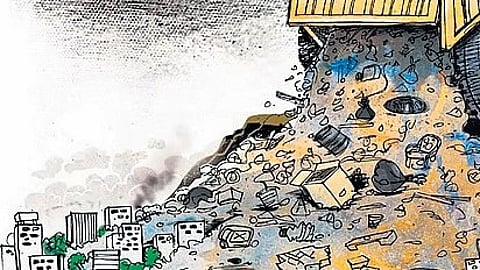

BENGALURU: Waste management is a major concern in Bengaluru, as the garbage piling up cannot be utilised now. The city generates around 5000 tonnes of waste a day, and this is apart from the eight legacy waste units with piles of 86,40,784 tonnes (MT) garbage which has little or no use.
The Karnataka Power Corporation Limited (KPCL) waste-to-energy plant in Bidadi does not accept legacy waste. It demands fresh, well segregated dry waste of 600 tonnes on a daily basis to generate 11.5MW power.
Greater Bengaluru Authority is also dragging its feet on setting up the biogas plant. After holding discussions for two years, an agreement was signed in September 2025 between GBA, Bengaluru Solid Waste Management Limited (BSWML) and Gas Authority of India Limited (GAIL), for setting up a waste-to-gas generation plant. Groundwork to set up the centre at the Karnataka Compost Development Corporation (KCDC) centre in Kudlu was finalised on 18 acres of land.
A GAIL official said, “Execution of the project will take 18 months. Soil testing is being done and environmental clearances being obtained.” The plant will require 300 tonnes of segregated fresh wet waste every day to generate gas that can be used for domestic and commercial purposes.
Urban Development Department sources said, “Since waste in the dump yards has been piled for years, all the methane has escaped. It cannot be used for gasification or energy generation, making the piles of waste useless. Methane is the key element for gas or power generation. Bioremediation and biomining is the only solution before the corporation. . Companies are not showing interest and the ones that do, leave soon due to red tape and corruption.”
As per Rule-15 (ZJ) of Solid Waste Management Rules 2016, urban local authorities should investigate and analyze all open dump sites and existing operational dump sites for their potential of biomining and bioremediation.
Chief Executive Officer of BSWML, Karee Gowda said, in Mandur’s Phase-1 site, biomining for 9,25,000 MT of the total pile of 10,83,383 MT has started. Work for bioremediation at Bellahalli dump site has also started. However, work on the remaining six sites where 39,07,401 MT of legacy waste is piled, is yet to begin. Each of them are in different stages of progress. Biomining and bioremediation take a very long time due to the magnitude of the load. But there is no other alternative as there are no takers for the legacy waste, he said and added that they were tabulating the total cost of the waste in the city.
