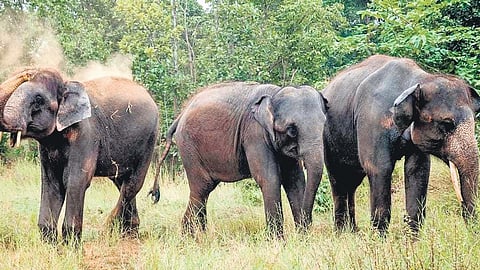

BHUBANESWAR: Contesting the outcome of the nationwide DNA-based elephant census which put Odisha’s jumbo count just around 900, the Odisha government has written to the Ministry of Environment, Forest and Climate Change (MoEFCC) as well as the Wildlife Institute of India (WII) which carried out the scientific enumeration.
Sources said the state Forest, Environment and Climate Change department and the Wildlife wing have submitted their feedbacks citing that the figure of Synchronous All-India Elephant Estimation (SAIEE) 2021-25 doesn’t reflect the accurate figure of state’s current elephant population.
The report, released recently, revealed that Odisha, which accounts for 57 per cent of the total elephant habitat in the central Indian landscape, accommodates only around 912 elephants. This is less than 50 pc of the state’s figure, which enumerated the population at over 2,100.
SAIEE also indicated changing colonisation patterns among the pachyderms in Odisha, suggesting that the shift could be a response to human development, with new habitats in western Odisha and south of the Mahanadi offering cooler climates, semi-perennial water sources and marshy lands.
A senior official from the state wildlife wing, however, told TNIE that the government has conveyed to the ministry the result of the All Odisha Elephant Census-2024. Carried out in November last year, it enumerated the elephant population at 2,103.
“The census had been carried out by the state government following all the norms and guidelines of MoEFCC, which is why we have our reservations about the WII-led census,” he said.
The officer said, the 2017 elephant census carried out in the state by MoEFCC had also estimated state’s elephant head count at 1,976. Besides, the DNA-based survey followed for the tigers is more appropriate for big cats as they are elusive. “We had followed the direct sighting method which has already been used in multiple states for elephant headcount exercis,” he said.
A retired forest officer also pointed out that the dung samples analysed in the SAIEE exercise were collected from only six divisions, which is why the result of the estimation is bound to be skewed. The official, however, opined that the DNA results can throw light on genetics, health parameters and dispersion. The SAIEE report also mentioned that the nationwide estimate, using the DNA-based mark-recapture method for the first time, should not be compared to the past figures and be treated only as a new monitoring baseline for future research.
