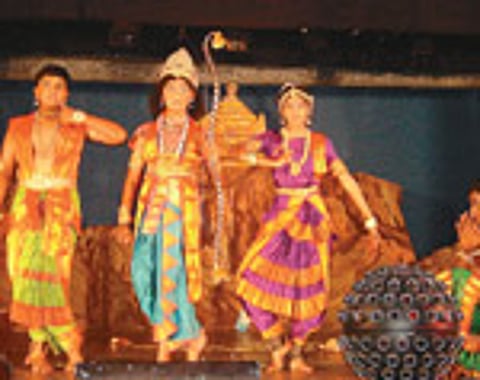

CHENNAI: Bharatanatyam and all forms of vocal expressions with dance, movement, speech and drama is considered the fifth Veda after Rig, Yajur, Sama and the Atharva Vedas. The spiritual truth is mostly so subtle that it cannot be grasped easily by the mind that is used to learning everything by the five senses of touch, taste, smell, sight and hearing.
Thus evolved the spiritual art of story telling through drama. In the traditional forms of communication such as Therukoothu in Tamil Nadu, the Yaksha Gana Bayalatta in Karnataka, the Gombeyatta, Togalu Bommalatta and other dance and music forms, the sutradhari will be the central character who narrates the tale - playing the role of our modern-day film directors. Plays woven around the stories of the Ramayana and the Mahabharatha, which had innumerable story possibilities with a moral or didactic message for life, were presented to village folks who stood around and watched. Building in all the emotional energy with Angika - physical movements with mudras and postures, Vachika - words and Aharya - make-up Abhinaya - expressions, any subtle truth such as Aham Brahmasmi - I am the Brahman, Tat Twam Asi - You are that God which you see, Ayam Athma Brahma - This soul is Brahman or Pragnanam Brahma - Consciousness is Brahman were explained.
In recent years too, many spiritual organisations have taken up drama in a big way to explain the truth and understanding behind the Sun as in Surya 108 by the Chinmaya Yuva Kendra of the Chinmaya Mission. Another successful play was the most unattainable and difficult concept of death, the life after, re-birth and reincarnation, the need to approach death in the most meditative manner, which was conveyed by the drama Death by the same group. One of their recent plays was on the Rivers of India where children of the Chinmaya Balvihar beautifully enacted the stories of the seven holy rivers - Ganga, Yamuna, Saraswati, Godavari, Kaveri, Narmada and Sindhu. The Chettinad Players comprising students of the Chettinad Vidyashram also brought plays from the Ramayana such as Vali Vadham highlighting the qualities of the less popular and even anti-heroes of the epic story. Students of the Kavi Bharati Vidyalaya school in Tiruvottriyur, enacted the story, history and mystery of the Tiruvottriyur area, the saints associated with it such as Ramalinga Vallalar and Pattinathar, the story of the origins of the Tiruvottriyur Vadivudaiamman temple in their drama as part of the annual day celebrations as also an episode from the Ramayana in yet another play. Not just plays, but the whole popular field of cinema began with stories from the epics such as Ramayana, Mahabharatha, Savitri, saints such as Meera, Agastya, stories of Shiva, Vishnu and other gods. Each of the epic tales and mythological stories offered a readymade platform for the beginning years of the film industry. It has till today retained the predominant quality of epics and life beliefs such as good fights and eventually triumphs over evil, reincarnation, law of karma and rebirth (Kamal Haasan’s Dasavatharam) and many popular films of Rajnikanth - like Chandramukhi and Baba - though they have modern-day stories to narrate, it is some anciently known spiritual truth that it subtly brings out.
swahilya.soulmate@gmail.com