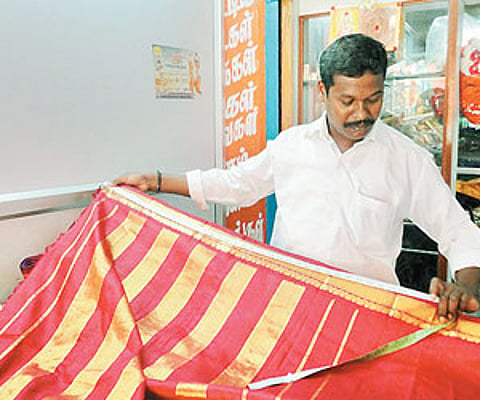

It is unlikely that a member of any traditional Brahmin household, preparing for a wedding or the like, has been spared the sight of a woman shedding her usual garb for a madisar. The nine-yard-sari, which was once donned on an everyday basis, has slowly morphed into a symbol of tradition to be worn at important religious functions. The madisar is not easy to drape; its bewildering length of fabric can succeed in confusing both the novice and the experienced drapee. In our ‘fast food’ world, where instant solutions are sought for seemingly large problems, it comes as no surprise, that the ready-made madisar has come to the rescue of many hapless women.
Seizing the business opportunity provided by a generation of modern, time-starved women, several enterprising tailors in the city have begun making readymade madisars. The customer only needs to provide them with the sari of appropriate length, and it is successfully converted a day later. The garment, now ready, need only be slipped on, much like a pair of pajamas.
“We have several women who wish to wear the madisar on important occasions but don’t know how to,” says R Venkatesh, who owns Renuka Tailors, a shop that has specialised in dance costumes for the last two decades.
Observing the rising demand for readymade madisars, Venkatesh decided to put the skills he’d acquired in sewing complicated dance dresses to good use. And the demand is witnessing a peak now, with more customers coming to him with such requests. “Women of all ages come to us,” he says. “No one wants to have to ask an older member of the family to help them tie the sari. Sometimes, they may not even have anyone to ask.”
Stitching charges, however, are not particularly low. Venkatesh charges `850 for an Iyengaar style madisar and `750 for Iyer-style. He also specialises in making readymade panchakachams, the traditional veshti worn by men, and depending on the amount of stitching involved, these can cost between `800 and `1,800. “But they are made to look very authentic,” Venkatesh says. “You could never tell they’ve been stitched that way.”
Draping the sari is an art in itself, and having to carry nine yards of fabric on the body can be cumbersome, especially if the wearer is constantly worrying about having to avoid being embarrassed by tripping over a trailing end. The ready-made option is, naturally, an attractive one.
Interestingly, the greatest demand for these items is from Indians living abroad, especially in USA and Canada. Often, NRIs take back stitched saris and veshtis, so that they are able to wear their traditional clothes back home too, even without any help. “We have had to make panchakachams for foreign grooms as well,” Venkatesh laughs.
Despite some stiff competition from their neighbour, Naidu Tailors, and others in the city, Venkatesh is happy with business, for the demand for these ready-to-wear items is only increasing everyday.
“We made one for singer Aruna Sairam recently,” he says proudly, picking up a pair of scissors and swiftly cutting the fabric on his crowded table. “Madisar and panchakacham wearing is a dying art. I wouldn’t be surprised if, in the near future, people stop wearing them. We’re here to help support their survival.”
