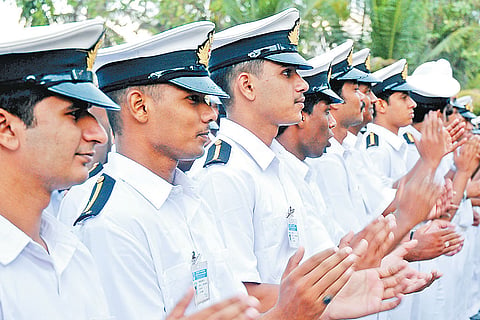

The intake of students in maritime institutes dropped by as much as 30 per cent and many smaller institutes are slowly closing down — and it’s all thanks to the global recession.
Many of the students are struggling to get onboard training in a vessel, which is a ticket for entry into the shipping sector. The major issue is that due to lack of cargo following the recession, not many ships are sailing — which is putting enormous pressure on institutes to get onboard training for their cadets, says Captain K Vivekanand, Vels University pro vice-chancellor.
The recession has hit even government institutes like Indian Maritime University, which blames the director general of shipping for allowing private operators to start their own institute. IMU’s former vice chancellor and now director of IMU’s Chennai campus P Vijayan said that after the director general of shipping allowed private operators to start their own institute, IMU has been finding it difficult to provide onboard training to its students.
Currently, there are 138 institutes that are approved for conducting various pre-sea training courses in nautical and engineering. They offer diplomas in nautical sciences, Bachelors in nautical sciences, marine engineering and other courses.
Vijayan says that IMU students were earlier getting sponsorship while joining the courses. But now, things have changed. Many big players like Great Eastern Company, Tolani and Samudra have started their own training centres, and as a result, the sponsorship for students has ceased. Even the Shipping Corporation of India has its own institute and does not accommodate students from outside, he says.
This has resulted in institutes looking to smaller operators. Although students in institutes of repute get opportunities through campus placement cells, those in lesser known institutes are the ones who are struggling. Interestingly, many institutes are even willing to pay money to the ship to get onboard training but there aretoo few ships.
This has resulted in the springing up of licenced Recruitment and Placement Services (RPS). Vivekanand alleges that the agents of RPS are fleecing the students. There is a lack of transparency and many times the agents demand Rs 2 to Rs 3 lakh for getting placements. Many of them are so desperate to get training that they become victims of agents who cheat them by promising them training in a vessel after coughing up a huge sum. But the vessel is never to be found and neither is their money.
Vivekanand says the reason is that many students would have borrowed money from the bank to pursue their undergraduation in nautical science, which costs `8 lakh and a four-year marine engineering course, that costs around Rs 11 lakh. Once they finish the course they are in desperate need for money to repay the loans and become easy victims of these agents, he adds. Vijayan says that this happens in the case of average students who are desperate to get a job.
Meanwhile, the government has given the nod for onboard training on the inshore and offshore vessels. But Vivekanand says that it is not enough. Surprisingly, institutes like his are planning to have their own ship. “We are looking at bulk carriers that can be converted into trading ships. We are not looking for government support,” says Vivekanand.
Interestingly Union shipping secretary P K Sinha is also aware of these issues. However, he blamed the global recession and said once things become normal, the sector will thrive. Then it will it be easier for the students to tide away the recession on the shores as the debts start to mount.
As the maritime institutes are slowly closing down, Vivekanand says this is not a good sign for the shipping sector. “Once, the recession is over, the shipping industry will need sailors but won’t be able to find many,” he adds.