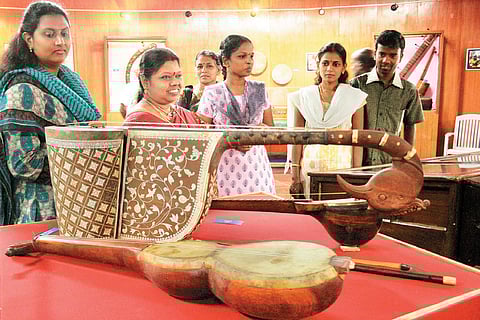

It is a visual treat for music lovers. Musical instruments that find a mention in the Tamil classical literary work of the Sangam period in 200 BC, are part of the exhibits at the Government Museum now.
Jointly organised by the Department of Museum and the Government Music College, the exhibits at the Centenary Exhibition Hall include 65 ancient instruments — string, wind and percussion — that were brought to the museum around 1903.
The yazh or harp-like stringed instrument and its various forms are on display. Mayil Yazh resembles a peacock in wood with carvings made of ivory. The number of strings differs. Vil yazh that resembles a bow is the highlight of the exhibition among others.
According to curator Tulasi Brinda, yazh instruments have been mentioned in classical literary works like Silapathikaram. “These instruments are open stringed and have a boat-shaped resonator and an ebony stem. Later in the early middle ages came the rudra veena and then the veena made of bronze metal in the 17th Century in Tanjore, during the period of ruler Ragunatha Nayak,” explains the curator. These instruments are being exhibited for the first time since they were brought to the museum.
There is also the Burmese Saung (yazh), regarded as the national instrument of Burma (Myanmar) — a boat-shaped instrument made of wood and adorned with semi-precious gems. It has been designed on the same principles as that of our Sengottu yazh, and, according to the curator, it is still played in Myanmar during occasions.
Apart from the various types of yazh, other string instruments like the rudra veena, panchagi veena, sitar, rabab and tuntuna (an instrument played by the tribals) are also on display.
Various shapes and sizes of percussion instruments like small damaru (a two-headed drum), kanjira and the large panchamukha vadyam (a metal drum) can also been seen at the exhibition. The panchamukha vadyam is a drum made of bronze with five faces covered with skin and named after the faces of lord Shiva. The center face is slightly larger than the others around it and is played with both hands. They are still in use at Shiva temples in Thiruvarur and Thiruthuraipoondi, the curator says.
Different sizes of shenais are some of the wind instruments on display. The painted ceramic bowls of Jalatharangam and Kashtatarangi or the xylophone have also been exhibited. “All the instruments were collected in 1903 or within a period of 10 years after that. The yazh and rudra veena can be only seen here. We have been maintaining them by giving chemical treatment regularly,” the curator adds.
The exhibition is on till March 3.