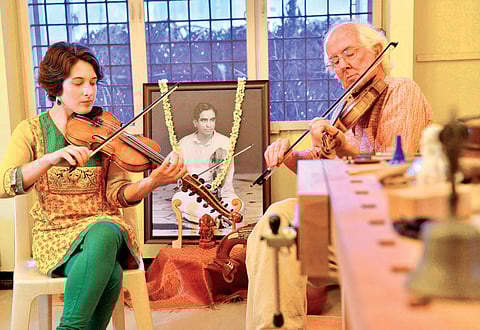

This Margazhi season, concert violins might sound a little different and better, all thanks to the violin restoration training being held under the auspices of the Lalgudi Trust by professional violin maker James Wimmer from the US.
When you enter the residence of renowned violinist, vocalist and carnatic musician Lalgudi GJR Krishnan, you know that you are in a workshop with a difference. With parts of violin being dismantled and small bottles of hide glue strewn on the table, a group of seven people are undergoing an intensive workshop on violin restoration — a landmark event that is happening for the first time in India.
James Wimmer, who is conducting the 21-day workshop for a group that comprises those in the profession of repairing instruments and even a professional maker of the veena, calls his sessions that will conclude on November 28 ‘very intensive’.
He points to an amazing fact about the Western instrument that made its foray into the Indian music scene exactly 200 years ago.
“A beautiful thing about the violin is one never knows how long they can function. The first violin used in 1550 AD is still in use today. It can be in use for 1,000 years too,” he says.
“Our approach must be one of conservation. That is why it is very important to know the appropriate method. In fact, here there are many who use fevicol or super glue, in place of hide glue or animal glue, due to a lack of training,” he adds.
Wimmer says that a complete violin restoration involves dismantling the necessary parts that need to be repaired and putting them back. “Animal glue can hold the parts for 500 years, but when we want them to come apart they will and water can be used to clean them,” he says.
Wimmer is not just a professional violin maker, but also a musician who took to music, escaping to Europe, after his degree in German Literature failed to get him a job. Possibly, acquiring his music influences from his musician mother who was a jazz pianist, he performed and toured the continent extensively for the next 10 years.
Eventually, the call of the violin beckoned him to explore a different terrain in the world of music and he trained in Germany under master violin makers Wolfgang Uebel and Herbert Rainer Knobel
He was introduced to Indian classical instruments like the sarod during a trip to Varanasi and the carnatic violin in Thanjavur, when he heard the instrument being played by a couple of people at a temple. “I was completely fascinated by Venkataramanujam playing the violin and wanted to know more about it,” he says.
Ask him about his favourite carnatic compositions, and Wimmer immediately renders vathapi ganapathim baje and mahaganapthim manasa with an ease to illustrate his love for the genre of music. He adds, “My all-time favourite is Lalgudi G Jayaraman’s Naa Jeevadhara. It takes 30 years to understand it and I have been listening to it for all these years,” he says.