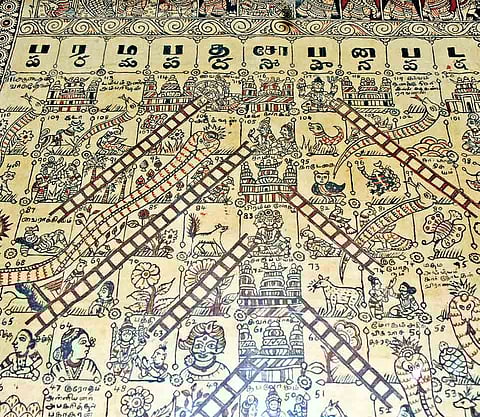

The Government Museum has on display a Kalamkari painting that depicts ‘Paramapadham’ (dice game) in an exhibition that is on till September 22.
The exhibition aims to impart knowledge about the ancient snake and ladder game with moral themes and to shed more light on the traditional kalamkari technique, say museum officials.
The kalamkari painting, which is exhibited at the museum, depicts the dice game or snake and ladders in English, dates back to the 19th Century. The game is also known as parama pada sopanam, which means steps to the highest place (parama pada means highest abode and sopanam means steps).
The game is believed to symbolise a man’s attempt to reach god. The ladders represent virtues and the snakes denote vices. It is said that people used to play during the night of Vaikunta Ekadasi to avoid sleep.
Kalamkari literally means the art of designing using a pen. The art of painting on a cloth with dyes is mostly prevalent in States like Gujarat, Andhra Pradesh and Tamil Nadu. Kalamkari works are made using natural vegetable and mineral dyes for colouring.
It was travellers like Francois Bernier noticed and wrote about kalamkari and other textile arts of India during his travels. It is believed that the technique originated in Andhra Pradesh. The tradition of kalamkari paintings got a major boost during the reign of Mughal rulers of the Golconda region of the State.
Officials of the museum noted that during the 16th and 17th centuries, two styles of kalamkari art emerged — one native to Masulipatnam in Golconda and the other to Srikalahasti in Coromandel — both located in Andhra Pradesh.
Masulipatnam style of kalamkari mainly features trees, flowers, creepers and leaf designs.
The style has a high influence of Persian forms. Though Masulipatnam work is also referred to as kalamkari, it is made using hand carved blocks to print the designs.
The Srikalahasti style of the painting that is influenced by Indian temples consists of paintings from epics such as Ramayana and Mahabharata.