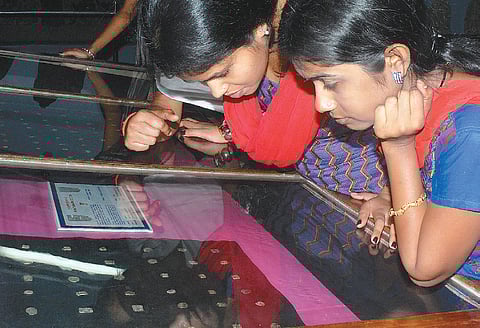

An entry into the Government Museum in Egmore would throw open the gates of a history dating back to 2500 years for visitors, thanks to the display of 4th century BC punch-marked silver coins.
The coins, referred to as punch-marked due to an unique punching technique adopted for its making, are the contribution of the Magadha Kingdom that ruled the present-day Bihar and Uttar Pradesh States in North India.
“Like the Euro, which is a common currency for several European nations, the punch-marked coins were in circulation in several kingdoms spread across Afghanistan, India and Sri Lanka,” said N Sundararajan, curator, Numismatics Section, Government Museum, Egmore. “With Tamils having trade links with the Magadha Kingdom, these coins were circulated in the South as well. The punch-marked coins are the oldest uniformed coinage of India, available in the country,” he added.
Sun is the main symbol in the Magadha of coins. The appearance of taurine marks complete with six armed wheels are also found on them. The secondary symbols like elephant and bull can been seen on these coins, apart from the flowering plant, snake, peacock, deer and dharma chakra.
The punch-marked coins had an unique manufacturing technique. According to a handout, more than one die was used in the ancient punching technique, whereas in the present coin-making technique only one die is used to imprint the image on the coin. This unique manufacturing technique gave the label ‘punch-marked’ to the coins.
A total number of 373 coins were unearthed from the Vaigainallur village in Kulithalai Taulk of Karur district in October 2008, each weighing about three grams. Of these, 120 selected coins are on display at the museum, as part of the exhibit of the week programme, on till March 10.