
CHENNAI: The lilting strains of Armenian instruments Saz and Qamancha echo in the courtyard of the church, and the exhibition banners flutter in gentle breeze.
The serenity and understated beauty of the Armenian Church at Parry’s is an ideal location for the exhibition, that is part of the Madras Day celebrations.
Tracing the journey of the Armenian community, the exhibition tells the story of their forced eviction from their homeland Julfa in Persia and the settling of the Armenian merchants across the globe, including Madras, in the 17th century. They were initially in the White Town, and were later expelled to Black Town, where the street is now named after them.
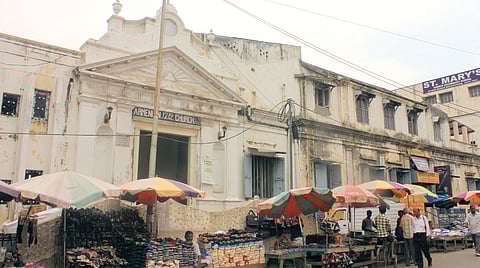
The street is crowded and the church is nearly obscured by the colourful awnings of the shops selling slippers and plastics and the fast food restaurant that is being run in a part of the church. But once inside, the white walls and greenery of the inside take over. Although the church is not as ornamental as the Armenian churches around the world. The trees and the interplay of outdoor and indoor spaces give the church its charm.
Satenig Batwagan from Paris, who has put together the exhibition upon the request of one of the Madras Week organisers Vincent D’Souza welcomes the visitors. With a doctorate in Armenian Studies specialising in Armenians in Madras, she is actively involved in researching the subject and this is her second trip to the city. “We are a very nostalgic community, as we were forced away from our homeland and have yearned to go back,” she says.
Her grandparents were survivors of the genocide and settled in France, along with several refugees as the European countries were in dire need of workers after the First World War.
But they still long for home, and younger people like Satenig have made Armenian studies their life.
“My grandparents still say in their homeland, the grape was better and the water was sweeter,” she says with a laugh.

Satenig says that the Armenian community in Madras was a well-informed lot with people who wrote about the Enlightenment and philosophy. A book published by Armenians in Madras is what piqued her interest in the city and her community’s roots in it. The first Armenian newspaper too, was published from the city by Haruthium Shmavonian, whose tomb is at the site, along with the belfry and the church. The church caretaker Trevor Alexander says that the paintings at the entrance of the church were done by the last pucca Armenian in Chennai, George Gregorian, who died in 2002 at the age of 91. Although the church is open to the public every day until the afternoon, visitors are rare, and mass is held only once a year when the Armenian Association of Calcutta visits the city.
But Trevor still lights a candle every day, the belfry still has its six bells, and the church stands serenely in the memory of a community, long after its descendants are scattered in new homelands.