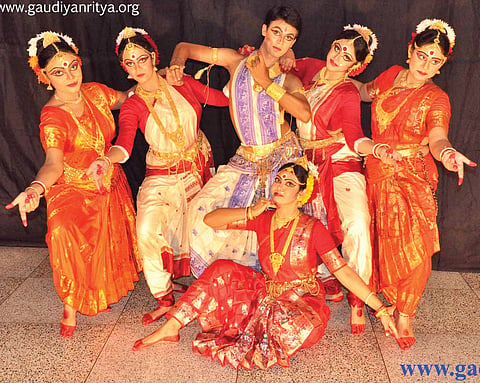

CHENNAI: It was a visit to the Ananta Vasudeva Temple in Hooghly that triggered the spark to explore the dance form that would have existed in Bengal. Thanks to her untiring efforts, Gaudiya Nritya, which was extinct by the 20th century, has been revived and deemed classical dance status by the Sangeet Natak Akademi. Mahua Mukherjee has spent several decades in bringing the dance form, which has its roots in Bengal, back to the main stage.
“It was such a beautiful place with magnificent sculptures. I began thinking what kind of dance form could have existed here. My love for dance and research opened the world of Gaudiya Nritya to me. I spent time researching various works, starting from the Natyashastra that serves as the base for all dance forms, to literature and the various temples across Bengal, where the dance form took shape. It was as though the dance form was in the middle and every aspect I concentrated on was like a petal, which opened up one by one to reveal Gaudiya Nritya,” says Mahua, who is the founder-director of Gaudiya Nritya Bharati and the dean of faculty at Fine Arts Rabindra Bharati University, Kolkata.
Mahua’s extensive research includes studying some of the oldest literary works and visiting temples across the State. She says, “There are strong references to the art form in Shrihastamuktavali and Sangeet Damodara by Pandit Shubhankara. The story of Behula refers to a housewife, who is from Bengal, dancing in the courts of Lord Indra. Bengal has a long history of the devadasi tradition in temples.”
Mahua has revived close to 50 compositions in the repertoire — Vandana, Mangalacharan, Alapchari, Dashavatar, Putana Badh, Mahisasura Mardini, Abhimanyu Badh and Ekalavya’s Gurudakshina. “The dance form actually never vanished, if you go by the evidence in the temples,” she says.
Trained by a bevy of experts, she was under the tutelage of Shashi Mahato in nachni or dasi dance and Narottam Sanyal in kirtan nritya and sangeet. She received training in Purulia Chhau from Padmashree Gambhir Singh Murrah, abhinaya from Padma Bhushan Kalanidhi Narayanan and shastra and Sanskrit from Manabendu Bandopadhya.
Mahua, who has trained many students in the dance form, is a recipient of a Fulbright Fellowship and has taught at Oklahama University. Her performances have taken her to some of the prestigious stages in India and abroad. She is also the author of 13 books that include Gaudiya Nritya, Banglar Laukik Nritya, Bharotiya Nritye Trayee, Juddha Nritya of Bengal and Gaud Banger Devdasi.
Mahua Mukherjee, who chose dance, despite a PhD in Botany, owes her dedication to her childhood. She says, “That was almost 50 years ago, when there was no distraction in the form of TV, radio or the Internet. I spent considerable amounts of time in Chhattisgarh, where I was exposed to dance. I used to perform in events during festivals, when my parents were not keen about me pursuing it. But I was attracted towards it. My husband has supported me in my endeavour with his painstaking efforts.”
Mahua Mukherjee and her troupe will perform at the Vasant Utsav organised by Saraswathi Educational Cultural and Charitable Trust at the Kapaleeswarar Temple on May 2. She will be honoured at the event with Indra Gariyali Award for her contribution to Gaudiya Nritya. She will also perform on May 3 at 7 pm at the Tamil Nadu Eyal Isai Nataka Mandram.
Where it All Began
Finding mention in Bharata Muni’s Natyashastra, which refers to it as Oudra Maghdi dance, Gaudiya Nritya was widely performed between the 4th and 18th centuries. However, during the early part of the 20th century, it lost its prominence and slipped into extinction due to lack of patronage. Gaudiya (old Bengal) and nritya (dance) includes chhau dance, which is replete with heroic elements, nachni, which has shringara elements, kushan, which is the story of Lav-Kush and kirtan. With a lot of circular movements, Gaudiya Nritya is a mix of rigid and flexible elements.
