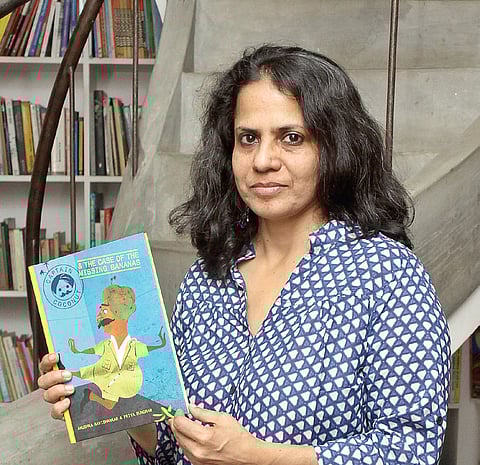

An eight-year-old boy is seen drawing a pumpkin-headed detective with potato eyes and a brinjal nose, while a little girl is busy colouring her sketch in deep green and blue, as we hear the sound of papers rustling and pens scratching. “What’s more interesting than making kids come up with their own stories or art?” asks Delhi-based Indian children’s writer-poet Anushka Ravishankar. At her workshop titled ‘Create a Detective’ by Tara Books, Anushka spoke about her latest book Captain Coconut and the Case of the Missing Bananas, and offered useful tips to the kids on how to weave a scene from their own creative characters and sketches. CE caught up with the award-winning author-playwright, who made a stopover in the city recently:
What’s Captain Coconut and the Case of the Missing Bananas all about?
Mrs Y had purchased 14 bananas, out of which four were eaten by her family. The next day, she wakes up to find that four bananas are missing. How the detective tracks the tough case forms the rest of the story. And you know what? My next work is its sequel!
Harry Potter aside, if one were to ask anyone to name a few Indian authors for children — the only two names that surface are Ruskin Bond and R K Narayan. Are we lagging behind when it comes to children’s literature?
I grew up reading British authors including Lewis Carroll, Enid Blyton, Nancy Drew and Edward Lear. No doubt, Alice in Wonderland, Little Men and the works of Charles Dickens are my biggest inspirations. The trend is actually getting better. Publishing a book isn’t as tough as it was 20 years ago. But it is a known fact that the majority of the young reading population in India prefer the books that are published abroad. Independent Indian publishers are bringing quality to children’s literature by churning out content through contemporary well-written stories and tasteful illustrations. In fact, it is a huge challenge to get kids read to books.
Your previous titles like Tiger on a Tree and Catch that Crocodile sound so adventurous. You must have had a wonderful childhood...
Hey, I had a deprived childhood. There were no crocodiles, monsters or fishes in it. (Laughs) But I started writing children’s stories for my own interest. After my daughter was born, I had to tell her interesting stuff. So, it became more specific.
When do you mostly write and where do the ideas come from?
Almost every book has come about differently. I enjoy the whole process of how a book evolves. Starting from planning to working with different illustrators etc., it’s challenging. I have over 30 titles to my credit, besides plays. Mostly, I write at night. That’s when the house is silent with no door bells or phones ringing!
How easy or tough is it to write children’s literature?
Although I’m a graduate in Math, I love to cook up funny stories. But you see, I don’t write to teach or moralise anything. So, it’s fun. I churn out nonsense, not literally though (grins). But sadly... this isn’t even recognised as a genre, right? As you grow older, we lose the ability to accept nonsense.