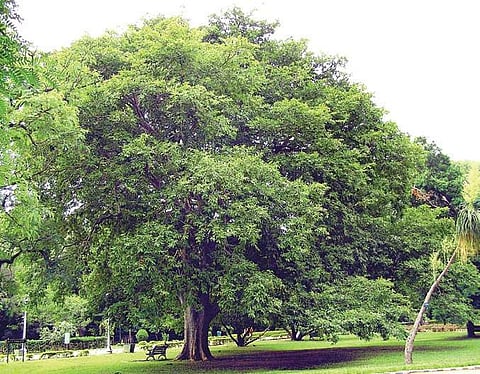

CHENNAI: This tree bears the same name as Arjuna, a great hero of the Bhagavad-Gita from the epic Mahabharata, known as it is for its strength and majesty and perennial nature. In Tamil Nadu, Arjuna tree is known as Maruthu and worshipped as the living symbol of Lord Subramanya and Marutha malai (hill of Arjun Tree) is considered his seventh abode. “Ohm, Surasevithaya namaha! Arjuna patram samarpayami” is chanted by offering Arjuna leaves to Lord Ganesh during the Patra Pooja!
Arjuna is a handsome, deciduous, large tree with a broad crown and shallow roots. Bark is grey or pinkish-green, smooth, thick and exfoliating in papery flakes; inner bark smooth and white, exuding red resin which turns black when exposed. Branches are spreading and drooping. Leaves are large, opposite, thick and with single or pair of foliar glands at the base; margins are minutely saw-edged and smooth. Flowers, which appear in April to May, are fragrant, bisexual, small, white to creamy and come in long spike inflorescence. Fruits grow up to 5 cm long, are dark brown to reddish-brown, woody, winged, with 5-7 raised ribs. They ripen from February-May.
Arjuna is the most important tree in Ayurveda, Siddha and Unani besides non-codified folk system of medicine. Fresh leaves’ juice is used to relieve earache. Bark is reportedly used in the treatment of heart diseases as a cardiac tonic, in bilious affections, for sores and as an antidote to poisons. According to our traditional systems of medicine, there is only one main way to care for our hearts! It is by drinking Arjuna tree bark juice or Arjuna arishtam (also named as Partha arishtam, another name for Arjuna).
It is reported that Arjuna bark has been used in Indian systems of medicine for at least 3,000 years as a remedy for heart ailments. Interestingly, this drug is even believed to be able to reverse heart failures! Arjuna tree is found only in India and Sri Lanka. In India, the tree occurs along the streamlets of dry to moist deciduous forests of peninsular India, Bihar, Madhya Pradesh, and in the sub-Himalayan tracts.
Terminalia arjuna (Roxb.) Wight & Arn. is the scientific name of Maruthu and it belongs to the botanical family Combretatceae. Bili matthi/ Hole matthi is the name in Kannada. Neer maruthu is the name in Malayalam and Tella Maddi in Telugu.
