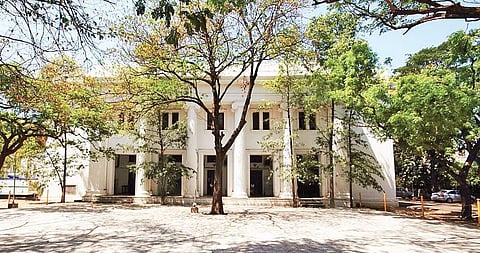

For the 300th anniversary of United Grand Lodge of England of Freemasonry, historian Sriram V has launched a book titled, Brotherhood and Benevolence. The coffee-table book weaves the history of Freemasonry in South India, looks at some ‘masonic temples’ that still stands tall and also streets named after masons.
CHENNAI: The idea of closed societies and century-old ancient brotherhoods is fascinating for all, but not many Chennaiites are aware that one such brotherhood existed in our city for over 200 years. Freemasonry was brought by the British, though there is substantial evidence of masonic symbols in early 16th century Dutch settlements at Pulicat. This year, the United Grand Lodge of England of Freemasonry celebrates its 300th anniversary, and in celebration, a coffee-table book on its history in South India was launched in Chennai.

Authored by historian, Sriram V and Karthik A Bhatt, the book Brotherhood and Benevolence, chronicles the Freemasonry brotherhood’s history in the Coromandel Coast from the 1700s till date. Speaking to the author, Sriram, and the past district grandmaster of the Freemason lodge in Chennai, KRN Menon, CE finds out what Freemasonry is all about and how it helped shape Chennai as we know it today. Seated in the library of the District Grand Lodge of Madras, Egmore, Menon explains, “Freemasonry takes good men, and makes them better.
It is based on certain moral principles, and has got nothing to do with religion. We propagate the basic tenets that all religions propgate — honesty, fidelity and obedience. Unfortunately, we became infamous for secrecy, more than the others.” India was perhaps the first masonic agglomeration outside the British Isles. The first lodge was in Calcutta, and the second, which still exists today, is the one in Madras. “When the British came in, they were amid a hostile population — so they wanted to be together, and feel safe.
That’s how Freemasonry came to India,” he adds. “Till around the 1960s, it consisted majorly of Europeans with very few high-ranking Indians.” Freemasonry was meant as a society which will help its own people, in life and in death, like in cases where a member passes away, the Masonry will help support the family. Over time, they also started to focus on charity. “In the early 1800s, they set up an orphanage (called asylums in those days) in Madras to take care of children of masons who had died.
That asylum grew over time, and is known today as the St George’s School and Orphanage in Kilpauk. It’s one of the oldest schools in the city,” says Sriram, adding the money for charity is collected from members only, and they strictly never publicise their work. “Just as they are secretive about their proceedings, they’re secretive about their charity,” he quips. The book, Brotherhood and Benevolence, took one year to complete, and weaves the history of Freemasonry in South India with how it impacted the city.
“It’s as much a social history as it is a Masonic history,” says Sriram. Referring to the meticulously maintained records of minutes of meetings, and a prior book titled History of Freemasonry on the Coast of Coromandel by Reverend C Malden, they could connect certain Masons’ names with Chennai’s history. “FW Ellis, an East India Company servant, who was a great devotee of Thiruvalluvar, strongly believed in Freemasonry. He translated the Thirukkural to English in 1818. Imagine his nobility that he could appreciate a different language and write translations! His tombstone has a Tamil translation of the Thirukkural!” shares Sriram.
From the early 1900s, Indian names started appearing. “Pammal Vijayaranga Sambandha Mudaliar, who is described as ‘the founding father of modern Tamil theatre’, was a prominent mason. He started the Suguna Vilasa Sabha, which is today a social club on Mount Road,” he adds. Like finding known names in Masonic records, and discovering known places in the city as Masonic ‘temples’ (the meeting place of the Masons) was equally enjoyable for the avid historian. “We went around the city, and stumbled upon masonic locations which we thought wouldn’t exist anymore.
In the end of the book, a photographic summary of these places has been given,” smiles Sriram. Some of these places are Fort St George, the old jail premises in Broadway, now called Bharathi Women’s College. “The most famous building they built is the present police headquarters. It was built in the 1840s as a Masonic temple, but it was far and lonely by the sea, so they sold it to the police,” laughs Sriram. The present District Grand Lodge of Madras is situated in a 200-acre land in Egmore, and the Freemason’s hall was built around 1925 and still maintained in its pristine condition. “The Freemasons believed in art, architecture, literature and charity.
They have acquired and collected several antiques over the years. It’s a kind of celebration of all things beautiful — Masonic regalia, century-old furniture, one of the lodges has a punch bowl which is over 200 years old. They have an original Ravi Varma painting, and a vast book collection many of which are out of print,” he points out. With this book, Sriram expects readers to realise how Freemasonry was perceived to be a very respectable body to get into.
“It is such an aspirational and honourable lifestyle. In fact, the brotherhood of masonry transcends the concept of war. During war, you could meet your fellow brethren even if your countries were at war,” he says, while KRN Menon adds, “The title of the book says it all. We are a brotherhood, and our main job is benevolence.”