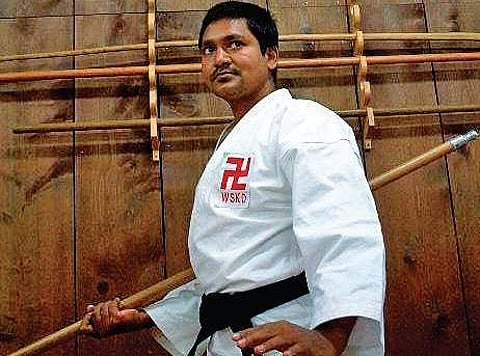

Shorinji Kempo, a form of Japanese martial arts, is rooted firmly in the principles of non-violence.Inspired by Buddhism, it offers an effective mode of defense, especially in the case of surprise attacks.
CHENNAI: Most people are quite familiar with various forms of martial arts like Karate, Kung Fu, Taekwondo, or Krav Maga. Each form teaches you to defend yourself using hard-trained reflexes, powerful punches, jabs, kicks and lunges. But did you know there’s a form of martial art that that does not use any form of violence? Training in Shorinji Kempo helps you in non-violence combat. Maxwell Jude Anthony, a city-based Shorinji Kempo practitioner of over 27 years, chats with CE about the history, methods of practicing and the types of meditation associated with the Buddhist martial art form.
Shorinji Kempo deals with the concept of non-violence that is expressed through Ikken Tasho (one fist can help many out of danger). “In Ikken Tasho, one doesn’t kill; instead, it is about mercy and compassion,”
says Maxwell.

Shorinji Kempo, which translates to Shaolin Temple Fist Method in Japanese, is a modified version of Shaolin Kung Fu, with a long history that traces back to 1947, when a man named Nakano Michiomi (Doshin So) introduced it the first time. This martial art form sticks to the old traditions and teachings of Buddhism (500 BC). “Arahan No Ken (Fist of a fighting monk) was a system taught by Gautama Buddha himself and we follow this system. He divided his entire teachings into two main segments — one for the Bhogis (ordinary people) who usually experience the world through the lens of material pleasure and use the five senses; and the other for the Yogis (extraordinary people) who use the third eye to live instead of the five senses...these are also usually the siddhas (those who have achieved enlightenment),” Maxwell explains.
What are the methods of practicing Shorinji Kempo? “There are mainly two kinds of meditation that is taught in Shorinji Kempo — Chin Kon Gyo and Ekkin Gyo. Chin Kon Gyo (static meditation) is when you sit absolutely still and achieve what we call nirvana (idyllic state), and in Ekkin Gyo (moving meditation) you are trained to be still even as you are moving, and this state is achieved by practicing superior breathe control,” he says.
He further adds that the former deals with a person’s internal journey and hence focuses on two Mudras (movement or gesture) and three Bandhans (locks). “It is the Buddhist way of creating awareness through three parts of the body — chin, lower abdomen and anus.”
Maxwell has a fourth degree black belt in Shorinji Kempo (the highest being ninth), and says it is an effective form of defense that requires minimal physical manoeuvering. “In the majority of crimes, the attackers are known to the victims. Ikken Tasho is apt in such situations, as it is a type of camouflaged fighting. The assailant will never know what stopped them...which makes it apt for surprise attacks,” he points out. The technique is used to tackle and defend incorporates the science of Meridians or Keimyaku Hiko and Acupoints or Atemi. “In terms of Indian sciences, the former is commonly referred to as Marma adi and the latter is called Varma adi,”he avers.
Maxwell says that though a majority of students at the Dojo (space of knowledge) are men, he does train women too. “A lot of people are not aware of this martial art. They assume that it is necessary for them to have a muscular body to practice Ikken Tasho. You do not need muscles to protect and defend yourself, and that is exactly what Shorinji Kempo teaches you,” he smiles.
For details visit their FB page:ShorinjiKempoIndia
Static meditation
MUDRAS
BANDHANS