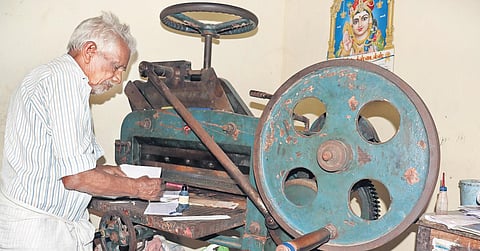

CHENNAI: ‘Stop the presses!’ became a thing of the past when digital printing found its groove. Ever since, business for manual printing press owners sorely jolted, and the pandemic only made matters worse. TNIE lensmen capture the plight and sight of printing equipment as owners recall the past and share their ordeals after the modernisation of the machine on which their life depends.
Green & Co Parvathi Press, Chennai
Rusty signage, teakwood ceiling, pale green-coloured walls, machines and printing tools that are over eight decades old. Tucked amid the myriad shops on Royapettah High Road, Green & Co Parvathi Press, an 87-year-old printing press, stands testament to the city’s rich publishing and printing industry. Started by S Chengalvaraya Mudaliar along with Kanakaroya Mudaliar, the unassuming shop has been in the location, which once belonged to the Arcot Nawabs, and was a stable for the royal horses, since 1932. Issuing thousands of prints over the years, the press has kept its age-old machines including a machine from Germany, and its tradition of manual printing and binding, running for 87 years now. “My grandfather worked in a different press in Triplicane after which he migrated to Burma and Bombay for work. After a few years, he returned to Chennai to set up this printing press,” shares CN Ramalingam, who along with his brother CN Ravamanickam takes care of the complex. In 1950, the press was taken over by their father Nagalingam, and a few decades later, the demand for manual prints saw a decline. Computerised prints had by then become the preferred option. The business of manual printing presses across the state started dwindling. The printing press, in its now dust-caked shelves, holds type cases from a bygone era in varying sizes and alphabets (English and Tamil) that are occasionally recast to maintain its sharpness. “The factories that manufacture type cases have shut shop. They are now used at the shop only when a customer gives a special order for manual prints,” he notes. Printing and binding invitation cards, visiting cards, school and office bill books, letter pads and posters are the regular orders, which the press receives. However, the income is hardly enough to cover maintenance expenses of the shop. The press, which once catered to patrons like former chief minister CN Anna Durai, is now holding on to its former glory and taking it one day at a time.

Printing presses in Madurai
When you enter Soman’s house it is like travelling back in time. There is a letterpress printing machine on one end and two big wooden shelves houses blocks that were used to print the material. Among the rows of blocks are those of deities, alphabets, logos, and much more. Soman started Vekadeswara Printing Press in Mumbai 30 years ago. With the advent of desktop publishing, he soon ran out of business and returned to his hometown, Madurai. But to remember the machine that served him in the past, he brought back a letterpress printing machine, that he now maintains at his house. Similarly, Thirugnanam started his printing press business, Kanmani Printers in 1973. With modernisation taking roots even in this industry he was forced to sell all his old equipment.
Printing presses in Vellore
Gnanavel (61), Nedumaran (63) and Natarajan (77), owners of small-time standalone printing presses in Vellore have, over the last several decades, grown up listening to the sounds of manual presses stamping words and alphabets, cutting paper and whatnots. “I was 15 years old when I started working at a printing press. In 1980, I started my press. Earlier, we were thriving but now, we hardly have any customers,” rues Gnanavel. Concurring, septuagenarian Natarajan, who has seen better days in his six decade-odd journey in the field, is now surviving by printing simple bill books. “I recently sold one of the oldest machines that I owned. I bought it for `15,000 and I sold it for `25,000,” he says. Nedumaran, who has been running his press since 1978 now uses his machines just to print wedding invitations and specific elements on the card including basic lines. “With technological advancements and people preferring automatic over manual, people like us and our business are in the brink of extinction. The future is uncertain,” says the GR Palayam-based sexagenarian.
The New Saravana Book Binding, Coimbatore
At a time when we are all rooting for Made in India products, in the bustling streets of Town Hall in Coimbatore, stands a building that houses one of India’s oldest printing equipment. Owned by T Saravana Murugan, the press stands testimony to the fact that old is indeed gold. Standing amid equipment such as single colour letterpress and paper-cutting machine, the 42-year-old recounts the past. “My father used this machine for more than 50 years. In fact, I have also worked with the machine when I used to help my father. When we used to work on this, we would print around 2,000 copies of bill books, wedding cards, etc., in one hour,” he shares. Even though now they have upgraded themselves to modern machines, Saravana maintains the old equipment in his godown as a memory of a pleasant past.
Shri Ratnam Press, Thirunelveli
My father, Ratnam, worked in a printing press for a few years in Melapayam before he decided to start his own about four decades ago,” shares Jayapal, the second-generation owner of Shri Ratnam Press, West Car Street. What was once a thriving business, where the machines along with its handful of workers functioned round the clock has now slowed its pace due to dipping demand. “Now, there is only one worker in the printing press and the two of us keep the shop open to cater to one or two customers, who step in to place orders for manual prints,” he narrates. The shop prints covers for jewellery stores and coffee shops and uses the fee to take care of the type cases and the machines. “This has been our profession for several decades now and without this, we aren’t sure what to do. Until we get a few regular orders, we will keep the doors open. It was a struggle during the pandemic when we had to temporarily shut the store. I am now happy to just keep the machine running,” he sums up.