
CHENNAI: Thogai, peeli, koonthal, sigi, sigandi, thoovi, koozhal, mayuram…the peacock, much before it enjoyed the status of being the national bird of India from 1963, was revered and referred to by 58 traditional names in the Sangam literature — the earliest literature of south India — during the 3rd century BC. Eminent scholars of that era observed the salient features and behavioural patterns of the bird and used it as a figure of speech in their works.
“Seventy-three of 473 poets have written poems on peacocks. The bird is mentioned in 142 poems. The poets appreciated the beauty and dance of peacocks and compared their body parts to that of flowers and human beings. It was used as a simile,” shared MC Sathyanarayana, in his seminar for DakshinaChitra organised by the interns of the museum management department.
The virtual lecture was a part of their week-long annual exhibition ‘Mayura – A Celebration of the Peacock’, which highlighted valuable stories about the peacock in Indian history, folklore, music, religion, and popular culture. In his two-part presentation, the retired associate professor of the Department of Zoology and Wildlife Biology, AVC College, Mayiladuthurai packed 30 years of his research and fieldwork under the topics, The Peacock in Sangam Literature and The Indian Blue Peafowl (Peacock) and its Ecology and Behaviour.
Beauty and the bird
Offering insight into the glorious references of the peacock in some of the well-known literary works, he began, “The bird finds a place in Ainkurunuru, Kurunthogai, Purananuru, Silapathikaram, and Natrinai. They’ve described a peacock elegantly resting on a swaying branch of a mango tree. A woman’s hair, gait, and facial features are compared to a peacock’s dance. The poets have observed and extensively written about parts of the bird such as head, neck, train feathers, eyes, calls, and habitat.”

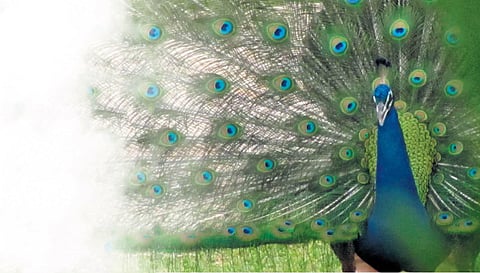
Cut to the present day, while much has been studied, researched, and documented about the morphology, biological characteristics, and social pattern of the peafowl, it’s the basics that need to be understood, he points out. Male and female peafowl, with a lifespan of 20 years, are drastically different in appearance. Peacocks are extravagant birds with iridescent blue necks and bright green tail feathers dotted with eyespots. Peahens possess a dull brown hue, iridescent green necks and cream-coloured heads.
Explaining their distinct breeding behaviour, he detailed, “Their habitat predominantly comprises village cropland, forests, and urban areas. Peacocks are polygynous and peahens are polyandrous. Peafowl establishes a display area called lek — a small territory maintained by each male. It’s used for courtship and visual and auditory performances. Peacocks make use of the same site every season. They maintain multiple leks. Leks close to each other involve territorial conflict. Males prefer open spaces to have increased and clear visibility and aggregation of females. Females, in groups or alone, visit leks to compare male physical strength, and for fertilisation.” Leks are established in the interconnected paths of traffic routes used by females when moving between different areas.
Males perform stereotyped displays called struts. They exhibit different types of courtship behaviours like fanning their train features (a cluster of long-tail coverts that spread out to form a fan several feet high extending down to the ground on both sides) to attract the peahen’s attention. The display activity begins at first with sunlight and the feathers reflect a different colour as the angle of illumination changes. “Display by males is initiated by April and goes on till October. The frequency increases by the month and is highest in the mornings. It lasts for four to 120 minutes and takes place 30 times in the morning and five times in the evening. Eggs are laid post-fertilisation and only females are involved in prenatal care. The Shanghai scientists of Fudan University found that the gradual change in colour of the feathers is because of the two-dimensional, crystal-like structures they comprise and not pigments,” he said.
Beyond what meets the eye
A crucial phase in a peacock’s life cycle is the shedding of train feathers that happens in October. The feathers wear out and lose functionality after display, post the breeding season, and then regenerate. Bringing our attention to an economic activity that thrived on the feathers even during the Sangam era, he informed us, “The peacocks were exported to the western world mostly from Madurai, Uraiyur, and Korkai as it generated substantial revenue. Villagers collect the shed feathers in various parts of India and sell them to retailers, who further sell them to wholesalers even today. As a conservationist, I wouldn’t oppose selling naturally shed feathers as it can contribute to our economy. But it should never be plucked forcefully from the birds and that can be identified by examining their roots under low magnification of a stereoscopic microscope.”
Under section 51 A (G) of the Indian constitution, as per animal protection laws and regulations, it’s the fundamental duty of every citizen to have compassion for all living creatures. Peacocks are protected under schedule 1 section 51 (1-a) of the Wildlife (Protection) Act 1972, which states that killing a peacock and exporting its feathers can lead to three to seven years of imprisonment with a fine of `10,000. However, the domestic trade of naturally shed features is allowed under section 43 (3) (A), section 44, and section 49 (A). Despite having such stringent legal protection, the bird often falls prey to farmer-peafowl conflict for its marauding nature in the agricultural fields. “While religious sentiments often rescue the bird, farmers are forced to employ various mechanisms to keep them away from the field. Scarecrows, poisoning pesticides, reflective tapes, and audible bird scarers are a few techniques. Instead, the crop damage assessment should be conducted and compensation must be given,” he said.
Fortunately, the national bird does not fall under the endangered species category. “Rajasthan, Tamil Nadu (Pudukottai, Madurai, Ramanathapuram up to Tirunelveli), and protected forest areas have a sizable population of peafowls. Real estate urbanisation has cleared the trees frequented by the peacocks for resting and that has forced them to migrate to the interiors.
The population is widely distributed and we don’t have proper statistics. It’s also difficult to conduct a survey as we have to go for the roost site count (where they sleep) and it demands manpower. There’s still a lot that can be done to preserve the bird. I’m always open to guiding students and researchers with the wealth of information I’ve accumulated over the decades regarding the bird,” he concluded.
Feather facts
Peacock feathers should never be plucked forcefully from the birds. It can be identified by examining their roots under low magnification of a stereoscopic microscope. A chemical test to show the presence of blood on the roots of plucked feathers was used to corroborate the plucked origin of feathers.