
CHENNAI : Abdul Shahi Muhammed is an ace Ajrakh handblocking artisan in Gujarat’s Ajrakhpur village. Right from his childhood, crafting new designs gave him great joy. After the devastating Gujarat earthquake of 2001, however, Abdul left the traditional art of his Khatri community as his passion could not fetch him adequate income. Abdul did several odd jobs for years. But, eventually, he returned to Ajrakh blocking. Nothing else gave him satisfaction.
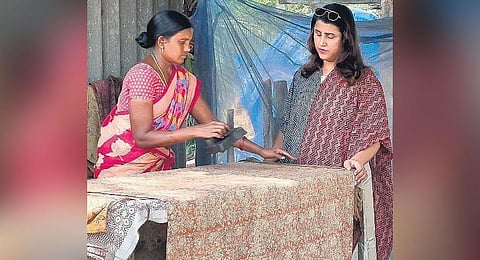
Like Abdul, unheard stories of handblock artisans of Kalahasti, Dhamdka, Bagru, and Machilipatnam will be told through a travel documentary by designer and founder of the clothing brand Klum, Prajina Jaanaki. Exploring the Indian block print’s rich cultural history and the deft hands behind the intricate motifs, Prajina headed out to India’s villages to capture the lives of the artisans. “Handblocking is a tedious process,” says Prajina, who plans to pitch the documentary to an OTT platform.

“No machinery is involved, and the effort and time put in by the artisans deserve to be highlighted. Nuanced hand blocking hasn’t gained much prominence in the Indian textile scene. It is an art that needs to be viewed at deeper levels. Through this documentary, I want the artisans’ effort, and the process to reach a global audience. I believe there hasn’t been any such documentary showcasing Indian handblocking.”
Klum — which, she says, resonates with the idea of ‘refreshing’ — was born in 2016 at Thamarassery, Kozhikode. Known for having introduced over 800 Kalamkari prints, Klum started experimenting with and organic handblocking, and presented prints such as ajrakh, dabu, pen kalamkari, gaamthi, bagru and vanaspathi. The prints are crafted on cotton, linen, handloom, mulberry and gajji silk. Utilising the age-old craft of dyeing and colouring a fabric using a wooden block, Prajina aims to make handblock prints a luxury and support the artisans.
“The hard work behind each print and fabric is enough to label the final product a luxury,” she says, adding, “some people, however, overlook the work and question the price.”
Stories of many cultures
Along with Klum partner Shyjal Shameem Ahmmed and creative director Binoy Karamen, Prajina travelled to remote villages across India and spent days with artisans. “These villages have unique cultures and are known for particular handblock prints. It was quite fascinating to watch the colourful prints of divine figures, humans, birds and animals take form,” she says.
In Ajrakh handblock printing, the cloth material is soaked in water to remove starch. Once it is dried, the motifs are etched. The cloth is then drenched in natural dyes made from madder, camel dung, lime, and iron deposits. Kalamkari is mostly done by the women of rural areas. Clothes are soaked in a mixture of cow dung and water first, and then in buffalo milk. The process gives the fabric an off-white shade. After multiple rounds of dipping in natural mixtures, washing and sun drying, design outlines are done with charcoal quills.
Pen kalamkari consists of stories penned on fabric — florals, peacocks, and divine characters of Mahabharata and Ramayana are portrayed artistically. Gaamthi comes from the rural areas of Rajasthan and Gujarat. It is known for the generous use of red, black, and beige shades. Both Bagru and Dabu are done by the women artisans of Rajasthan. Bagru’s darker motifs are done on light-shades, while Dabu uses white motifs. Vanaspati handblocking is done using vegetable dyes, and the creations are done in a way that the natural beauty of the prints do not fade even after multiple washes.
The documentary will also showcase the not-so-popular Fadat prints — a mix of Bagru and Dhabu. Its making is more strenuous than the others. Incidentally, Klum’s recent collection, Dva Rasa, presents pairings of different prints.