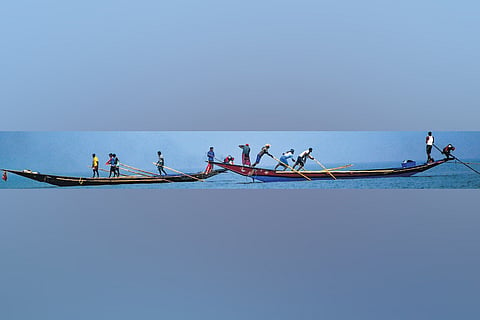

CHENNAI : “In a running ship, there are nine mariners.
Mariners need equipment and thread from Madurantakam.
Net made of thread which has survived for centuries.
Who else is on guard, this is Adi Shakti’s thread.
The guard knows the thoughts of each one.”
– one of N Palayam’s four collected ‘ambaa paadalgal’.
Navigating the rocky seas with no land in sight, fisherpersons scour past the tides searching the vast ocean for daily catch. In the past, while loading boats with nets, lines, bait, and kanji, no fisher would forget the lines of their trusty ambaa paatu. “Fisherfolk would sing ambaa paatu while starting the boat, loading nets, pulling the fish to the shore, and while keeping their sleep away. While returning, their arms will hurt and their hands will burn using the oars. One would feel they are tortured, I have wept feeling like death would be better. We sing the ambaa paatu for bravery, discipline, and strength,” says 60-year-old Palayam N.
Mingling breath, movement, and prayers, these songs reflect and record the lives, culture, and deities of the fishing communities and the sea that they call home. At the recent Urur Olcott Kuppam Vizha, Palayam sang a few lines of the fast-disappearing ambaa paatu, reviving a culture that has been lost through time, and ushering the long-sidelined melody to the mainstream stage. Against the backdrop of the Sridevi Ellaiamman Temple, the festival — themed Living Ocean, life-giving Ocean — put a spotlight on different strands of music including Carnatic music, parai, ambaa paatu and light music.
Ways of sea-ing
The history of these songs in Urur Olcott Kuppam dates back to a time when Besant Nagar was a forest, and communities lived in houses woven with palm fronds and coconut leaves, says Palayam. His tryst with ambaa paatu, fishing, and the sea began as a teenager when his parents and sibling passed. “If I continued my education, my family of two sisters and one brother would have been on the streets; so I began stitching nets, and clearing them. At this time, I learned about the ways of the ocean, life around me taught me about it. The knowledge of traditional fishermen communities is amazing,” he says.
From various words for winds and currents (like olini, which is a term for powerful current), predicting storms, to mapping nature’s trends, the sea carries many lessons and the fisherfolk have a detailed language to decode its waves. Beyond this, music lies in the waves, shore, wind and clouds. Citing the example of Kannadasan’s Odum megangale in the 1965 film Aayirathil Oruvan, Palayam says, “he came to the beaches and shore to write this song. See how a composer’s piece becomes a hit song after going to the beach.”
As for ambaa paatu, over the years, its essence has seeped into mainstream culture, and cinema, for instance with the line ‘Ailasa ailasa’ in AR Rahman’s Aathukulle Ayira Meenu in the film Thiruda Thiruda. “Eylei lo ailasa, when we sing these two lines, we get energised. In the film industry, the director gives the story and then there will be stunts, songs, and other forms of art. While the film gets musical composition, it gets its life. But ambaa paatu is not like that, its mark is beyond usual tempo, beat, and expectation,” Palayam points out.
Ambaa paatu or jalsa paatu are categorised as labour songs, with no clear strand of origin in written records. According to researcher Vareethiah Konstantine, these songs belong to the fisher society. “This culture descended from tribals when they hunted. In our rural environment, these songs reflect their life, and prayers, imagination, and sarcasm, folklore are in this paatu. If you look closely, it reflects the time and life of these people. These are the reliable records of the life of the people,” he says.
In his book Kadalamma Pesringa Kannu! Vareethiah adds that music and tunes inform their activities — there are songs for pulling the catch of the day or working together, putting children to sleep, or opparis to grieve their dead.

Anchor of music
Far from a song with talas, ragas and aestheticism, ambaa paatu eases the fatigue of fisherfolk and is essential to their labour process. In the 2017 vizha, Palayam recalls hearing fisher Murungakkai singing the songs of Nagore Andavar, a 16th-century Muslim Sufi saint, and the sea, on stage. “His voice was so loud that it could be heard in places, three houses away. He could recall only two lines of the song but had forgotten the rest of it. If those two lines itself were so meaningful, what about the 10 more lines? I told him, you belong to the earlier days, if the ambaa song is learned from you, we will preserve it like a life and spread it,” he says.
Following this, Palayam began recording and collecting these labour songs from fisherpersons like Panchamirtham and Murungakkai. One such song centres around Nagore Andavar, praying for protection and aid. In one, Nagore Andavar is a king who helps shoulder burden while casting and pulling up nets. “For the fish, we pray to Nagore Andavar, as only he comes to the middle of the ocean to help us,” says Palayam. Many songs of the community are intertwined with their local deities, and conventions of fishing.
Today, with mechanised fishing processes, ambaa paatu is a dying music form. But every morning, as he sets out to the sea, Palayam starts his boat and the unmistakable tunes of the ambaa paatu follow, with prayers for safety and a net full of catch.