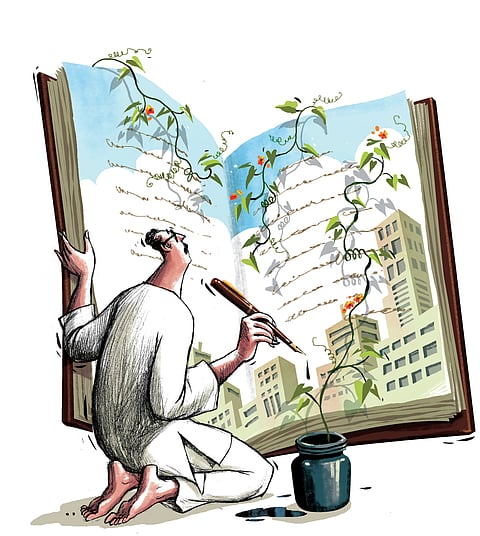

CHENNAI: Poetry, since time immemorial, has existed in the world in various forms — in the language of revolution, in the screams of oppression, in the futility of wars, in life, death, grief, in nascent love, in brewing rage. But it exists without defining contours. Largely, poetry is a metaphor for individuality, yet it is astounding how someone’s craft of words and thoughts can appear so familiar, withstanding the waves of unfamiliarity.
For poets and readers, falling for poetry can be sometimes a spontaneous, and sometimes a slow process. I would want to rather describe it as a love language between thoughts and words, an attempt to express amorphous thoughts, to not tame them but give them a place to exist, bare and bleak. Poets from the city share their intimate dialogues with words, forms, and the creation of poetry.
Shriram Sivaramakrishnan, a theatre artiste and playwright who also conducts independent poetry workshops for students and adult learners in the city, says, “Poetry is a space that allows one to be, without being pushed to conform to any definition. Poetry is a space where one can exist without being asked to vacate. In this place, there is no expectation, there is no reader, it’s just you.”
Engaging in poetry bestows different kinds of impression, for some it’s a solitary experience, but for some it’s a way to connect with the outer world. Sivakami Velliangiri, a senior poet, who is keen on introducing poetry to youngsters, says that poetry is a way of reaching out to the outside world, as she recalls her exposure to poetry when she was at school. She says, "Unable to produce the exact words of the poem ‘The kite’, I expressed my own take on it. This found a place on the front satin cover of our school magazine with a ‘kite’ appliquéd on it.” This juncture ushered her to writing more poems for her school magazine. She recalls, “My first published poem was in 1977 in Youth Times."
BREAKING MONOTONY
In the humdrum routine work, in the hurry burry of city life, amid our appeasing performative roles, poetry is sometimes an escapade. Shriram who steered off to explore the expanse of poetry and do what really matters to him, says, “In the society we live, it’s so difficult to be a failure. In spaces like relationships, family, profession, if you are a failure, it comes with consequences. Engaging in poetry is a solitary experience where the witness is you and the white page.”
For K Srilata, poet, fiction writer, translator, and academic, writing poetry helps anchor her in the moment. She says, “Poetry helps me pay attention to the small things we don’t notice while rushing around, or sometimes that your brain is censoring out, and sometimes we feel they are not worthy of attention.” Even if she feels they are not material for a poem she would like to publish, she tries to write what she feels like. She says, “I like my own solitude, but being an only child also meant I had to figure a lot of things out. Poetry helped me do that at a very young age.”
Sivakami, also known as the ‘Poetry Aunty of Chennai’, who sails on a sea of different genres — continental and contemporary poetry, poetry of the diaspora and regional Indian poetry — feels that writing is a compulsion. “I write because I have to. It is a way of life,” she says.
Poetry could be “the spontaneous overflow of powerful emotions”, as Wordsworth says. It could also be as Srilata says, “a way of telling truth” referring to Emily Dickinson’s words, “Tell all the truth, but tell it slant”.
For Shriram, writing poetry is a way to express an emotional turmoil, and he feels that even if he revisits his works, it need not always convey meaning. He busts the conception that society holds on meaning making, draws parallel between poetry and happiness, and says, “You don’t understand it, you enjoy it. I just write, it need not coagulate into anything.”
For Sivakami, the lines form in her head first, she keeps mulling over it before finding a convenient spot and time to jot it down. Then editing follows.
EXPERIMENTS
Creating by breaking rules and deviating routes, each poem is moulded by different poets by transcending themes, movements, styles, forms, and so they cannot be pigeonholed. Shriram tries new ways of writing, and captures the essence in different ways. He says, “I try visual poems, I scribble, sometimes I write a word, strike it, and let it marinate in the junkyard called the mind.” He allows them to “co-exist and see if the lines are happy to be with each other.”
I wonder how someone could think of love and raspberry, draw an analogy between two entirely unrelated things. Shriram elaborates the “mystical love poem” he created. “Being in love is like having a box of raspberry. Both have the sense of wanting, but one can’t have it until its ready. In both cases, there is a need we feel to bond.” He says metaphorically, “If you allow your thoughts to roam, they become like wild horses.”
Srilata plays around with syntax, and sometimes tries to place her poems in conversations with that of others, and watches where it takes her.
Sivakami, who finds joy in being in a literary community, talks about her writing groups, The Waters Poetry, British Council Poetry Circle, where she says, “There is no payment, we only have to critique two other poets — that is the fee. She says, “I get a lot of inputs from there. Although this is a foreign group, there is equality here.”
RECURRENT THEMES
Themes in a poem are manifestation of poets’ life substantially, that act as windows opening up to their ways of looking at the world. Shriram says that he gravitates towards the concept of absurdity. Attributing to the genesis of his obsession for absurdity, one of the traits of the 19th century French poetry that shows some affinity towards objects, he says, “One of the things that fascinates me is the way how objects and language interact.” Horses and colour blue are the recurrent themes in his poems, which he feels could also be because he doesn’t understand them. “Blue is opaque and mute, and it resists understanding. Stand in front of it, you don’t anything out of it, and yet it draws your eyes in,” he says.
Srilata explores the themes of female lineage, difficult and happy work of care and nurture, inter-generational stories of trauma, women and ageing, growing up in a largely women-headed household, microlives of women, structures that are unusual, women wired differently, visible disability or an invisible disability. She says that she returns to these themes, without being aware of it. Sivakami says that she has explored anecdotal poetry, and hovered over the motifs like relationships and social injustice.
‘PERSONAL IS POLITICAL’
‘Personal is political’, a slogan echoing from the second-wave feminism of the late 1960s, placed in a larger context of art of all kinds, of all time, seeps into the cracks of all social and structural norms, upends them through strong personal narratives, bringing home a universal appeal.
Referring to the relevance of this slogan, Srilata says that after writing her poem ‘The Physiotherapist Asks’ that revolves around the theme of emotional pain, ageing of the body, she herself had qualms on the acceptance of such personal works. But she discovered that many could relate to it. She says,”A lot of my writings are personal — about families, the quieter sides, and invisible things. When you do it with a space of honesty and authenticity, it resonates with others, and that way it’s always universal.” Echoing this thought, Sivakami says that the “I” in the poem reverberates as the piece reaches the readers.
Shriram says, “Poetry to me is the most curious and most dangerous thing in the world. It has survived for years without having a market. A poem need not, and does not change anything in this world, and yet it exists. It has no utilitarian or evolutionary value."
He adds, “Poetry allows us to sit with our own powerlessness, allows us to connect with the person next to us. It helps us build community, and that is why poetry becomes political, even though it is hyperpersonal.”
Poetry has always stood the test of time. Shriram notes that it doesn’t have any market value, yet it thrives. It nudges me to think about the transcendence of poetry.
Read & enjoy
People who can write, comprehend the nuances of poetry, and can appreciate the form are often put on a pedestal. It is important to acknowledge the section of people who finds it difficult to interpret and decode poetry. K Srilata shares some tips for those in the process to learn and understand poetry
Take up training/course/ attend poetry workshops
Keep the process consistent, be it reading or writing
Recognise what genre interests you
Read contemporary writers
Make best use of poetry websites
You can appreciate a poetry without understanding it
Analysing is not an overnight process. Trust the process
A world of their own
Before getting into a world of imagination, one needs a proper space to get their creative juices flowing. From their own rooms to virtual communities, poets share about their favourite space to pen their work.
Sona Sherin J, content creator
In my room, the dark nook is a cozy spot. The dim lighting casts a mysterious ambiance, igniting my creativity. The soft cushions provide a comfortable seat as I begin to immerse myself in the world of words. It’s a place where I can escape the chaos of the outside world and focus on my thoughts and emotions. The quiet solitude allows me to delve into the depths of my imagination, where ideas flow freely and inspiration strikes like lightning. As I lose myself in the act of writing, time seems to stand still in the dark nook. The outside world fades away, leaving only me and the words.
Shruti M, assistant editor, Karadi Path Education Company
I’ve noticed that I’ve loved poetry the most in community spaces. The poetry club at my college was one such space — anyone who attended a session would leave with something they had written organically, and would feel motivated to share, even if they had never written before. I’ve attempted to recreate the feeling of enrichment and safety that creative space gave me through virtual community in the following years, through NaPoWriMo. Poetry has been more about feelings than words, and what better way to access that than with other people?

Shriram Sivaramakrishnan, poet, playwright, theatre artiste
I love going to coffee shops and libraries. In such places, when I am writing, I don’t want to connect to someone else’s gaze, because I am very vulnerable then. I love the openness of beaches, and then just looking at the horizon is absolutely magical. Higher the roof, the more I feel freedom. Open spaces bring something more vital in me. I love to stare at the distance without having someone between me and the horizon.
K Srilata, poet, writer
Space is always in short supply for all of us, especially when we come from a middle-class background. We all live in small apartment, and there are many people with us. Quite recently, I managed to have a space for myself — like a proper desk and a room. I have always imagined of a room that lets in a lot of air and light, and doesn’t have too much of clutter.
Pooja Kadaboina, senior editor, Karadi Tales
There is a wildly overgrown tree right outside my bedroom window. The chatter of the birds and squirrels that dwell in its recesses accompanies my thoughts as I write my heart out. I hope and imagine that someday I am, like my friends, a small being who will chirrup my poetry from behind the overgrowth while perched in a tree fork.
Pragathi Shankar, a multidisciplinary artist
I enjoy reading or writing poetry in my own company. I like it when it’s just me and my mind consumed by the chaos that govern my thoughts and feelings. Being in nature really grounds me, blurs all the noises and helps me focus on the art.