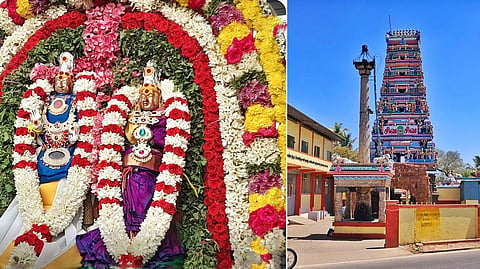

CHENNAI: Getting a darshan of lord Shiva at Arulmigu Manneeswarar Temple is considered significant, and the prayers are believed to be heard and fulfilled, too. This powerful temple is situated in Annur, 32 km away from Coimbatore.
The temple is notable for its architectural design, history, and religious practices, making it a prominent cultural and spiritual site in the region. The exact date of this temple’s inception is uncertain. However, its believed that the temple was built about 500 years ago by King Manuneethi Cholan, an ardent follower of lord Shiva. Oral history says that the king received a divine vision, instructing him to build a temple in honour of lord Shiva.
The rajagopuram of the temple is a seven-tier structure. There is also a wing-like form on each side of the Shivalinga that symbolises Garuda (the eagle vehicle of lord Vishnu). This wing-like form conveys that lord Shiva is closely watching our doings. There is also a scar on the Linga, denoting an injury caused by the weapon of a hunter.
There is a faith around this temple that if one lights up 21 lamps and make 21 pradakshinas, the sins of the next 21 generations would be pardoned by Shiva. There is also a belief that lord Sri Manneeswarar at Annur graces as a Swayambumurthi under the Kailasa Vimana at the sanctum in the colour of sand.
Special pujas are conducted in the temple on new moon days. Mother graces in the name of Arunthava Chelvi. The oonjal festival is celebrated each Friday, with devotees worshipping her that day for children. While Mother Durga graces in the Shiva prakara in temples, it is believed that all prayers are favourably responded at Durga’s shrine.

According to some epigraphic evidences, the place has a mention as Mel Thalai Thanjavur. There are shrines for Sun and Moon near the rajagopuram. Special pujas are performed on the first Sunday and Monday of Tamil months for Sun and Moon respectively early in the morning. There is a separate shrine for Saturn, also called as Sani Bhagwan. Dal and rice are offered as nivedhana to Saturn on Saturdays with pujas.
Going back to the mythological history, there is a story behind the creation of the temple. The region, many years ago, was densely infested with valli plants. A hunter, Anni, eked out his livelihood by hunting animals in this forest. Despite considering hunting as a sin, he had to do this for survival. He was not very well-equipped in any other work, too. One day, as he failed to hunt any animal, he tried digging the valli plant for its root. But, he found that the length of root stayed the same despite cutting it. Out of curiosity, he continued to dig further and discovered that the the root was bleeding. A voice echoed that all his sins had been pardoned. The hunter, nervously tried to articulate whatever that had happened to the king of the region. The king visited the spot and to his surprise, found a Shivalinga. He tried his best to pull out the Linga with a chain that was dragged by an elephant. But all efforts were in vain. In his dreams, the lord appeared; he advised to drop the efforts to pull out the Linga, as he wished to stay there itself. Therefore, the king built the temple in that spot.
To repent for the sins continuing from births of past and to gain forgiveness for wrongdoings committed knowingly or unknowingly, devotees seek the blessings from this temple.
The temple that faces west, has shrines for Bhairava, Jupiter (Guru Bhagwan), Nataraja, Muruga with his consorts Valli and Deivanai, Anjaneya, Nalvar, who sang the Thevaram and Tiruvasagam hymns and, Tiruneelakanda Nayanar. There are seven Nagar idols (snake idols) under the sacred valli tree in the Sarparaja shrine. Its speciality is the presiding deity, Swayambumurthy, facing west.
Brahmmotsavam in Margazhi, Chithirai and Vaikasi Puja, and Shivrathri are the important festivals celebrated in this temple.