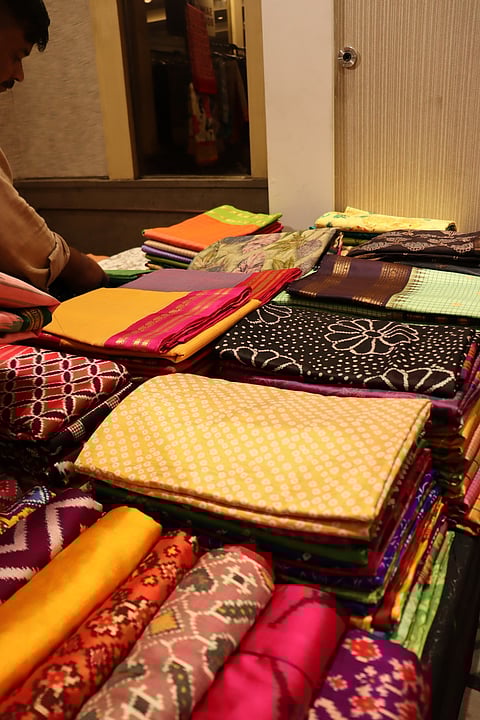

A sari can sometimes hold the trace of a mother’s love, the strength of a father in his koothu attire, or the stillness of a wooden chest that hasn’t been opened in years. It is this sense of history and connection that comes alive each August in Chennai. Through the Crafts Council of India’s annual textile exhibition, the MRC Centre opens its doors to a wide collection of textiles from across India.
“This year is very special because the Crafts Council of India is celebrating its 60th anniversary,” says Bela Khaleeli, executive committee member of the Crafts Council of India. “We’ve been doing this exhibition for over thirty years now. We have records going back 25 years, and even before that, the sale existed. It has a long legacy.”
The Crafts Council of India (CCI), a Chennai-based not-for-profit NGO, is run entirely by volunteers. “We don’t take any salary or compensation,” explains Bela Khaleeli. “But we still have a functioning secretariat. The sale helps generate the funds we need to keep that going.”
More than fundraising, the event is rooted in giving handloom artisans and craftspersons a dignified platform. “We began with weavers, especially handloom artisans who needed work. Over time, designers and entrepreneurs also joined, and the event grew, ” shares Bela.
The 2025 edition will bring together 42 vendors, each showcasing handwoven saris, fabrics, and garments that draw from traditional techniques and contemporary innovation. “We try to encourage handloom and handwoven textiles. That is at the heart of what we do. We don’t permit synthetics or machine embroidery — only handcrafted work is encouraged,” says Bela.

The curation process is slow and thoughtful. “Some vendors have been with us for years. They understand what the audience wants and tailor their collections accordingly. Vendors send us pictures of their work, and the committee reviews everything. It’s a process built on trust and experience.”
Among the collections this year is the gamcha series by Rimli Studios — a contemporary reinterpretation of the Bengali towel into saris and made-ups. There are also revivalist collections in jewel-toned Benares silks, organic cottons dyed from Nilgiri flowers, eco-printed fabrics using foraged flora, intricate Kalamkari on Chanderi, and hand-processed tussar silk from Odisha. “The event draws a lot of loyal visitors,” says Bela. “People in Chennai look forward to our sale. They come to do all kinds of shopping — festive, gifting, or just for the joy of discovering new weaves,” she adds.
And while the show continues to centre textiles, it also gently evolves. “We’ve had to expand beyond just saris and traditional fabrics. The market is changing. We now include readymade garments too, to appeal to a broader audience,” says Bela.
The Crafts Council of India , currently, has around 250 members and works with regional craft councils across 10 to 15 states. Its executive council of 17 members oversees the organisation’s activities, while the textile committee handles the sale each year.
For many artisans, participation in the CCI exhibition is an opportunity and recognition. As Malavika Phadke, another committee member, puts it, “The Crafts Council is a stepping stone to many things. Once someone exhibits here, doors open for them across India.”