
Along Poonamallee High Road in old Madras, the skyline has familiar landmarks — the red-brick bustle of Central Station, the cream-white Ripon Building, and the ornate Victoria Public Hall. The streets around these buildings in the 1900s throbbed without engines: tram bells, the creak of bullock carts, the soft whirr of bicycles, horse-drawn carriages, and the patter of hand-pulled rickshaws threading the roads.
Sepia-toned postcards of Madras often show the elegant horse-drawn carriages lining a lively Madras framed by colonial facades, capturing the graceful, animal-powered mobility that once defined the city. Contemporary accounts and scholarship even indicate a clear pecking order in price and prestige: horse carriages, typically used by the well-off — including British officials before 1947 — were costlier than human-pulled rickshaws, while slow bullock carts largely served goods transport and the frugal. Sustained by the fascination of the wealthy for elegant horse-drawn travel, opposite the Ripon Building was a long horse stand or stable where rows of horses and carriages waited, reins slacked, ready for hire.
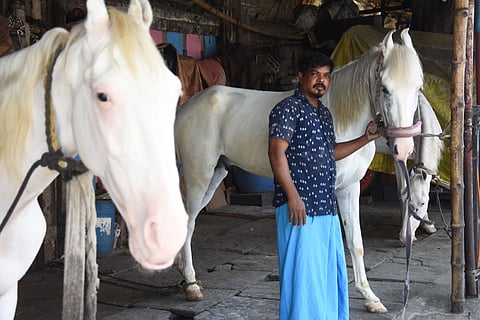
This institution is kept alive in memory by the three last horses that remain in the stable today. Named Danny, James, and Kabila, they are all under ten years of age. Their owner, S Kumar (40), represents the fourth generation at the horse stand. From his early years, he has borne witness to the slow fading away of both men and horses from the stable. While Kumar’s forefathers and father earned their living transporting people in horse carriages, the nature of the business changed completely when he entered the business.
“When I was just a boy, we still were transporting people in horse carriages, but after my father, when I took over, Chennai began to have more autorickshaws. There was no business for horses on the road,” he says, adding that he has since ventured into a new line of work — hiring out his horses for grand occasions ranging from weddings to political rallies. But this business, too, comes with its own challenges.

“Firstly, the work is seasonal. Only during wedding seasons do people hire horses. Then there are some political rallies they hire horses for. Previously, people would even hire to celebrate retired officers. They would want the retired person to be carried on horse-back as a send off. But today, we don’t get such hires often,” Kumar rues. Barring weddings’ seasonality comes another blow. Owing to the active shift toward more intimate, less ostentatious weddings, the demand for horses has declined sharply, he adds, making the business less profitable. According to Kumar, there have been times when his horses went without work for two straight months, only to be hired in the third month. Yet, even through months of idleness, the horses are cared for, washed, fed, and polished, as they wait by the roadside.
Caring for the horses, Kumar says, is a full-time job. “The lifespan of a horse completely depends on how well we maintain them,” he explains. “These horses are like our family members. We won’t let them carry very heavy chariots, or make them do difficult tasks,” he adds. His routine, therefore, revolves around a steady cycle of regular washing, careful grooming, feeding them grass, hay, and grains, providing water, and keeping them in good health.
All three horses, incidentally all male but intentionally all white to cope with Chennai’s heat, that Kumar owns were brought down from Maharashtra. “For decades together, we have been purchasing horses from there, but lately, the prices have surged. In place of `50,000 we were paying 10 years back, we are now paying `2 lakh,” he points out and explains that it hardly matters if a horse is male or female. They work based on how one trains them, he shares.
Horses are never simply fastened to a cart but trained. Since the young ones are hard to train, Kumar begins training them after they reach the age of four or five. First, they are taught to obey voice commands and follow gentle rein cues where the reins are left loose to allow natural movement. Gradually, they are introduced to harnesses and made to drag light objects. Once the horses feel calm and steady, a cart is attached. With time and repetition, the horses learn to trot and carry, becoming dependable carriage-pullers. This training takes a few weeks and may differ based on each horse, Kumar notes.
He complains, however, that medical care for the horses in the city is largely lacking. In earlier times, when horses were central to transport, there were plenty of doctors trained to tend to their health, but with their numbers dwindling in the city, only a handful of doctors with real experience remain today. “We provide basic treatments. I will know if my horse has a fever from its hot and foul-smelling breath. If my horse has leg pain, it will show by raising that leg, and I immediately apply medicine and massage the leg. But the danger begins if they develop a stomachache,” he says. According to Kumar, horses indicate that they have a stomach ache by pushing their legs inward towards their stomach, the way we might hold our stomach when it aches. “When that happens, we don’t feed them at all. We take them to the veterinarian immediately. But sadly, many horses today, including a few of mine and others who own horses and offer rides at the beach, have died after developing stomach aches.”
With no support from the government for their fading livelihood and scarce medical care, they persist in the business, Kumar laments. He longingly says he wishes Chennai had supported its carriage riders the way Kolkata did, as licensed horses still draw carriages through the heritage-lined streets there.
Even with difficulties that burden the business, Kumar’s 20-year-old son can still be found at the stand, a quiet reminder of continuity. Kumar admits he will never force him to stay. The youngster pursues his studies but also returns to the horse stand. And if one day, he decides to make a life from this work, “So be it,” concludes Kumar, with equal parts of resignation and pride.