
While discussing mental health narratives, it is of paramount importance not to bury the factors from which they stem. There is a need for these stories tethered to margins to be told, preserved, retold, and brought to the forefront. Systemic oppression, caste- and class-based injustices, childhood trauma, poverty, unemployment, inaccessibility to mental health care — these socio-economic factors can shroud one’s life. But we don’t hear such stories often, despite a rise in mental health discussions.
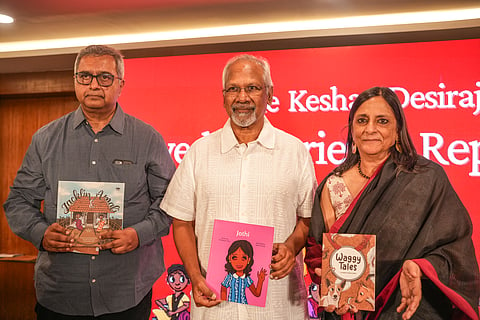
On Saturday, at Savera Hotel, one such initiative, dedicated to centring and preserving stories of the psyche from marginal socio-economic locations, called The Keshav Desiraju Lived Experience Repository, was launched. This project is created in memory of Keshav Desiraju, former Union Health Secretary, architect of India’s Mental Health Policy. Vandana Gopikumar, co-founder of The Banyan, explained the importance of the initiative. “It aims to centre diverse experiences drawn from a broad landscape — from a person who left home in search of her sister, who suffered a psychotic break, to a child carer, who saved her depressed mother’s life because she plainly expressed fear and the desire to live. There is no one way of understanding and learning from lived experience wisdom.”

At the event, a discussion, ‘In Conversation: Stories Art, and Care’, with filmmaker Mani Ratnam; production designer and artist Aradhana Seth; business head, Westland Books, Gautam Padmanabhan; lived-experienced experts, Srividya, and Kavipriya, centred on how to tell stories most truly and why these stories matter.
Mani Ratnam stressed that the emotional authenticity has to be kept intact. Aradhana, on retaining the complexity of mental health experiences through art, said that the spaces, characters, the everyday lives and the slightest details like ageing materials in a room — all these have to be done in subtle ways, but we can also dramatise emotions like “frenzy”. The conversation moved to discussing the shift we have been seeing in the narratives, as the panelists with lived experiences shared glimpses of their own mental illnesses — the gloom, the acceptance, and the resilience.
Undoubtedly, there are many first-person accounts in the form of memoirs, shared experiences today, but there is a wide cleft when it comes to inclusion and representation. Vandana said, “The first-person accounts are typically global north-centred; or if situated in the global south, they follow a particular aesthetic that represents the reality of a few, typically privileged. Consequently, overarching narratives that do not take into account systemic injustices or intersectionality are clumped together to represent a microcosm of emotions and social contexts, which, while important are limiting.”
Recording stories
Introduction to such real-life experiences was also the crux of the event. Jothi, a story of a woman named Jothi, was a way to keep her memories alive, almost tangible through words. Vandana shared a very close and personal bond with Jothi, who was one of the original members of the founding team, who grew on everyone she met. “She didn’t age at all in spirit...despite the many hardships that she had to face, she carried both her suffering and resilience with a sense of nonchalance and lightness and continued to remain spunky, loyal and determined.”
Finding a vocabulary to describe the dark demon, to draw the entangled web of despair, to explain the baggage of the past, for someone who does not belong to the entitled strata, isn’t quite easy. The team said, “In the early days of the organisation, when the vocabulary of lived experience expert did not exist, Jothi was already contributing in that capacity.” Amali, one of the main characters of Jacklin and Amali by Regha Jha, which was re-released at the event, said that she felt a sense of pride when she saw her story narrated. As Amali said, her story will be passed on to the young children. It’s also a way to understand mental health from a different lens. While such stories are told, many dimensions of who they were, are also explored.
Waggy Tales, another book, was also launched. It is a constant reminder that pets have always been a comfort to our pain, a companion for their lifetime. Arundhati Lakshmi Satish, the author, said, “The bond that dogs and humans share should not be overlooked as something ordinary; in fact, it is everything but ordinary.” The book with personal undertones is a collection of these wondrous connections between the people at The Banyan and dogs. Arundhati noted the words of a person whom she interviewed for the book, “The only reason I get out of bed every day is that I need to feed my dog. It gives me a purpose.”
Anushka Madhavan, illustrator of Waggy Tales and Jacklin and Amali, believes that grim and real subjects like “grief, poverty and homelessness” in the book had to be articulated in the most authentic ways. This creative process was also a space to ask herself how she could give a visual form to these subjects. She added, “The Banyan believes in an authentic display of emotions and allowing the viewer to see the light and the dark for what it is.” While Deepti George, illustrator of Jothi, who is fascinated by Japanese Manga and Chibi characters, says that she is inclined towards using bold colours, especially while showing “exaggerated features and expressions”.
With such a collection, Vandana hopes to bring new perspectives through books, art, comics, graphic novels, theatre, podcasts, fellowships, etc., that “will widen the social imagination around mental illness/ madness”. Remembering the cherished friend of The Banyan, she said, “Mr Keshav Desiarju, incidentally, always drew from real-world messy experiences that he integrated into the first Mental Health policy.”