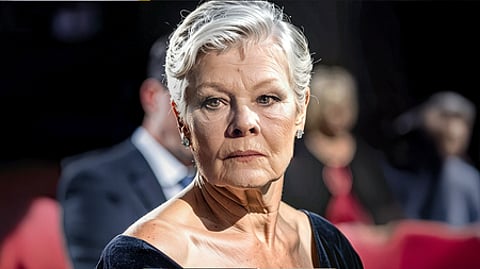

In a wide-ranging British press interview published earlier this month, veteran actor Judi Dench shared candid thoughts on three celebrities who faced allegations of sexual assault and battery: Kevin Spacey, Harvey Weinstein, and Johnny Depp. Of Kevin Spacey, who was acquitted of two sexual assault cases and must face three more trials next year, Judi Dench said that “he has been exonerated”, and that she is friendly with him. Of Harvey Weinstein, who is currently imprisoned and whose offences were behind much of Hollywood’s MeToo reckoning, she said, “I imagine he’s done his time… To me it’s personal — forgiveness.” She also swooned over Johnny Depp, whom she has a crush on, and whose ex-wife Amber Heard alleged had assaulted her (they went to court over defamation, not abuse).
During the height of the MeToo movement, Judi had firmly indicated that she is in the art-over-artist ethical camp, which values a person’s creative output or other attributes over their moral failings. She clearly continues to feel this way. All this is said knowing that Judi Dench is 91 years old, an age at which a fairly large margin for outdated or discourteous behaviour is owed to all. While she has certain illnesses and disabilities by this point, based on her recent conversations with the press at least, cognitive impairment isn’t among them. Her comments can be presumed to be about her actual values and principles, and as a public figure speaking to the media, they aren’t flippant. More importantly, the comments in this space here are not meant to indict her alone. Rather, they are about people who choose to defend predators in spite of the evidence, who still stack “(S)he didn’t do that to me” against the word of survivors and victims.
Predators often cultivate allies who defend and protect them, people who essentially serve as human shields, because their own reputations become tainted as they help preserve the image of the person they are supporting, either publicly or privately.
The ally of a predator is often a family member, friend, fan or employee. They enable impunity for and rehabilitation of the perpetrator. They may also enable more acts of unacceptable behaviour, not just from the person they choose to believe in, but from other culprits who see such behaviour being normalised or even concealed by consensus.
An enabler may be gullible, or may have trouble accepting facts that are too destabilising to their sense of self, other or the world itself, but the choice to put their weight behind a predatorial person is certainly not innocent. Upon hearing of the predator’s behaviour, an initial reaction of shock and disbelief, and even grief, is normal. Persistent denial, attempts to downplay the egregiousness of the situation, seemingly philosophical but fundamentally hollow expressions about forgiveness and second chances — these, however, signify outright abetting.
The world is full of enablers, and the insulation they provide to perpetrators is what keeps all kinds of interpersonal violence active, recurrent and without redressal. One would love to write Judi Dench’s sentiments off as being out of touch with the collective conscience, but that too would only be negation of a pervasive kind of harm.
