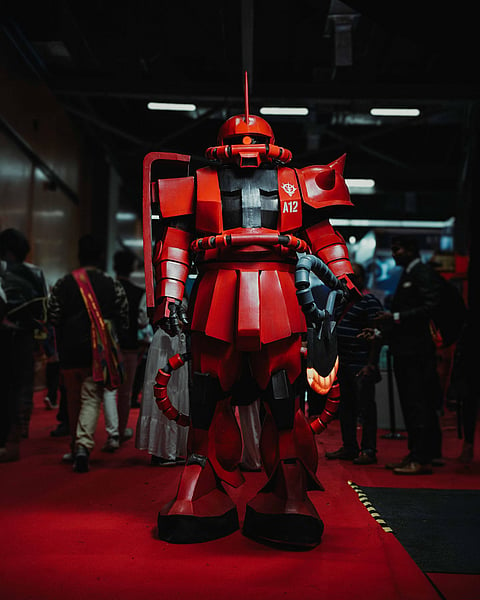

It was 2004. Fourth grader Gowtham Sekkilar would return from school to his silent home. His parents would be out snowed under work. This was when he turned to his 'companion' to kill his loneliness. This pal came from a different universe.
Now an AI engineer, Gowtham had given the nickname ‘companions’ to anime characters. He recalls, “I started watching anime when I was very young. My brother was in college at that time. He used to come back home and watch anime on the computer, and I sat beside him.” He not only watched the shows, but built a relationship with the world because he knew there was more to anime. More than just vibrant graphics and dramatic expressions, it was a safe space for him, a reflection of life, and a guide to his future.
The anime Hungry Heart inspired Gowtham to take up football. “I watched it because we used to play football in school. The show’s protagonist wanted to make a mark in the world, but he is also troubled and rebellious. He found solace in practising the sport after school hours.” Seeing the character, Gowtham started playing the game. After school, along with his friends, he found a spot and played football. Then, one of his teachers saw him play and pushed him to join sports. “I think anime does change you — at least your way of thought,” he notes.
Comforting frames
Anime is subtly influencing hearts, minds, and individual identities — from assisting teenagers in naming their feelings and providing comfort in this fast-paced world. From disproportionate figures to unknown, unheard language, anime has an impact on individuals. At its core, anime can be viewed as an escape from reality, a catharitic experience providing comfort, validation, and hope. “Anime connects with your emotions at times. There are many normal happenings that you can possibly relate to life, in terms of achieving something or going towards a perfect goal. It resonates with your sense of feeling,” points out Nilesh Subramanian, a cricketer.
For Nilesh, anime, especially Naruto, was the voice that soothed him when he was recovering from an accident in 2014. He explains, “Naruto is about how he [Naruto Uzumaki, the lead] wants to be accepted by the people around him. What resonated with me was that, at some point in life, we want to be accepted by someone that we like, and you start working towards it. But the sense of what you are working towards is totally different from how you are working towards it. That perspective changed while watching the show, and it makes so much sense.” This shift in viewpoint helped him move on with his career and the recovery. This incident hooked Nilesh to explore anime further.
Watching more series, he began to notice how storylines, though set in fantasy worlds, were similar to real-life emotions, events, conflicts, and journeys. He comments, “I started watching when I was 20-21-years old and I was able to understand the parallels that ran with what the real-life situations were about.” There are mentions of fascism, capitalism, and what freedom and order mean to people.
Adding to the list SP Praveen Raj aka Pvnstarlet, architect and graphic designer, mentions that the series One Piece has scenes about discrimination, slavery, and world politics. “One Piece is an anime about finding the greatest treasure, which is known as peace, shows how people with power can change anything and how history can be hidden. Discrimination is shown between human species and those that live in the sea and sky island — a practice we can relate to between the countries,” observes Praveen.

Learning lens
Anime often dives deeper into the building of its characters, especially its antagonists, offering more than just a good-versus-evil narrative.
Expanding on this portrayal, Nilesh adds, “A character wanting revenge is a simple plot. But in anime, you will be shown why he does that. Even if something wrong is happening, you will see the perspective of why that eventually happened.”
Zooming into different characters’ lives, anime offers multiple perspectives. Beyond this, many shows evolve based on viewers’ responses and recommendations. MS Raghul, aka Tamil_anime_psycho, a cosplayer and cosplay prop maker, shares, “Audiences who were reading Attack of Titan wrote a letter to the author stating that the ending is not good. The author publicly apologised and changed the end. That is how powerful this fanbase is. They find the authors close to them or somebody whom they can relate to.”
Raghul started watching anime during the pandemic and became a cosplayer after watching Dr. Stone. Here, the lead character, Senku Ishigami, sleeps only to find out that thousands of years have passed and he is currently living in the Stone Age. The doctor, then, reinvents everything, including the method to purify alcohol, magnets, and electricity generation. He also creates devices like steam engines, automobiles, and even a cell phone. “When I was an engineering student, I had this policy, where if I could not buy anything, I would make it myself. That is what Dr Stone was doing. That stayed with me and I transitioned into becoming a cosplayer,” Raghul expresses.
Dr. Stone was the show that attracted Vivaan V, a teenager, into this world of fiction during COVID-19 lockdown. “The main learning from anime is not giving up. The shows have a purpose. It teaches life lessons. I have watched several sports anime, which are inspiring, like Haikyuu, Kuruko’s basketball. It is more about how height does not matter in sports like basketball,” he says.
While some grew up watching anime, others discovered it during times when loneliness loomed over the world. There is comfort, connection, and quiet companionship that it offers through every arc and episode. “I still watch anime because it is a part of my childhood,” says Gowtham.
“Anime was there when no one else was. It helped me build my confidence,” says Praveen. What started as comics and TV series has now moved to Netflix shows and movies. Undoubtedly, anime subtly serves as a place for emotional release and develops a sense of self. However, its power is based on balance, much like all other kinds of art and escape. The headlines of a Japanese man, Akihiko Kondo, marrying a virtual character are troubling. It blurs the line between emotional connection and escapism and raises questions about how far one can retreat into fantasy before losing grip on reality.
Experts warn of this dependence on the make-believe world. When consumed with awareness, anime enhances life rather than merely reflecting it. Beyond the screen and the subtitles, it is suggested that anime should be viewed as a series that empowers viewers to dream big & create their own narratives.
Anime Suggestions by
SP Praveen Raj:
Ages 5-10: Pokémon, Digimon, Beyblade, Shinchan, Doraemon
From age 10: Dragon Ball Z, Naruto, Jujutsu Kaisen, Black clover, Haikyu, Code Geass, Hunter X Hunter
Above 18: Vinland Saga, Jojo, Steinsgate, Berserk, RE Zero, Monster, Pluto, Full metal alchemist, Dororo, Psycho pass, Violet Evergarden, High school DxD
Did you know?
Similar to Thirukkural and other poems in Tamil, the anime Monogatari is based on Japanese literature and themes. “If you are new to anime, it would be a slow running show, but for Japanese natives, they can relate to it as they learn it from their childhood,” says Praveen.