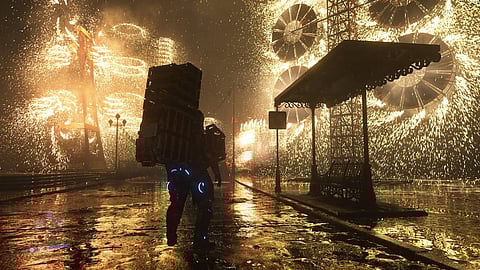

A couple of years back I played the first Death Stranding game on a PC and was rather dismissive of it; I called it a “relaxing game where you arrange things in a backpack”. A lot has already been said by many about the series being a glorified delivery simulator, but I don’t hold any of those opinions today. In the 60+ hours of playing the game, Death Stranding 2 has come to mean something so much more to me.
I think a lot about public infrastructure, maybe more than the average person. I wonder if the bridge that I cross every day will still stand a hundred years from now. I think about the effort it takes to create a tunnel for a metro line beneath the city’s surface, and the thousands of lives that pass through it without ever seeing the rock and earth that were moved to make it possible.
But I also notice the smaller things. Like the dirt path cutting diagonally across the grass in my neighbourhood park, made by repeated walking. The heavy cement slabs a nearby shop laid out by the flooded roadside – an improvised solution to a recurring problem. It’s an insignificant make-shift contribution that each of us make over an imperfect landscape. But somehow – all necessary. We’re all better for it.
In a strange way, Death Stranding 2 reminds me of all of this. Set in a post-apocalyptic world where ghosts, or 'Beached Things' haunt the living, and the rain called “timefall” rapidly decays and ages everything it touches – this world is filled with ruins of what used to be. Infrastructure is broken, and people live in isolated settlements. There are only a few who are brave enough to travel between them – the porters. And every ladder left behind by another porter, every dirt path and road rebuilt after the cursed “timefall” rain destroyed it – is a small attempt to hold the world together. While it is strictly a single-player game, it is also what Kojima calls a “strand-type” experience. Small actions have consequences – and quiet maintenance by the players (other porters) is what keeps the world from being destroyed. It’s genuinely heartwarming to see the in-game notifications when another player uses a “watchtower” I constructed, or “likes” a path I carved out by repeated travel. The asynchronous multiplayer experience makes every small contribution feel very meaningful.
A lot has changed in the world of the Death Stranding since the first game in 2019. The futuristic electricity + wifi + all-encompassing “chiral network” has connected most of the post-apocalyptic North American continent. And now, Sam Bridges takes the challenge of spreading it across another new place. He brings with him medicines, rare minerals, hacked data, and even rescued animals - whatever people need to survive. The world has new and improved equipment to combat the 'Beached Things'. There are better backpacks, vehicles, weapons - better everything. But also, worse enemies to face. New threats, and the unknown that lies in the subterranean “tar”. And the only way to get by is connecting the places under the network step by step, building a bridge, or a road, placing a shelter for other porters to sit out the timefall, or simply – just providing materials for other porters to come fill in and build back the world that once was.

Death Stranding forces you to live inside every single tedious moment. Playing as Sam you are forced to feel every kilometre of the journey hiked with a 75 kg backpack. At a safe point, you literally sit down and massage your shoulders to ease the strain. In a strange ritual of recovery, at the end of a delivery, you take a relaxed shower and wash off the “chiral crystals” and the blood from a terrifying encounter with bandits. Even upgrades are somehow deceptive – if you’ve somehow managed to build a monorail line between two major destinations, you must still watch the train moving past vast landscapes in real time. If you choose to “fast travel” – you must do so by abandoning your possessions – which really defeats the purpose as the only reason to travel fast is to deliver items. Kojima’s game has mastered the way of providing the illusion of automation and upgrades while the game steadily gets difficult – in terms of terrain, enemies, and fewer reliable transportation options.
Death Stranding 2 is currently a PlayStation 5 exclusive. It’s coming quite close to being my favourite game of this year, and I highly encourage PS5 owners to buy it – provided you are alright with spending a few hundred hours experiencing this game.