
How many of us have whispered secrets to our pets, believing they understand? Or stopped mid-step to watch a puppy chase its own tail? Or felt an unspoken bond with a stray? We think we’re the ones taking care of animals, but the truth is, they take care of us too — in ways we don’t always realise.
In many ways, animal welfare has been a lifelong lesson Maybe that’s why stepping into what looked like an actual school — empty classrooms, a playground, a basketball court — felt oddly fitting. And what’s a school without an auditorium? A large standing poster marked the entrance to the Blue Cross Memories & Milestones event, a celebration of sixty years of compassion. But beyond the nostalgia and applause, one question lingered — how much more do we still have to learn?
S Chinny Krishna, chairman of Blue Cross of India, took the stage. “Running any charity for 60 years is difficult. When this charity is in the animal welfare field, it is indeed a Herculean task. This is true even in a country like India — a country which gave the world the concept of Ahimsa, non-violence in thought, word or deed. Rarely does a founder get to celebrate a 60th anniversary, and I consider myself truly blessed to be here.”
Reflecting on the journey
Until 1987, Blue Cross ran entirely on volunteers, with their 24x7 ambulance service driven by off-duty Indian Airlines pilots. Yet, their work was recognised early — Captain Sundaram received the Royal Society for the Prevention of Cruelty to Animals’ Queen Victoria Medal in 1964. Over the decades, their activism led to major legislative wins — the bans on monkey exports (1978), frog leg exports (1987), and dolphinariums (2015). Other milestones followed: launching pet therapy for special children (1987), the Dr. Dog program (2001), the Water Bowl Project (2013), South India’s first animal crematorium (2021), and their first Mobile Hospital (2022).
But despite these victories, Chinny highlighted a growing crisis: abandonment. “Today, a major problem is the endless dumping of puppies and kittens outside our gates. Even adult so-called pedigrees are ruthlessly abandoned. These dogs cannot survive on the streets, and all shelters are overflowing.” He welcomed Chennai Corporation’s recent mandate for pet licenses and microchipping, hoping it would be enforced effectively.
Animal rights activist and environmentalist Maneka Gandhi said, “Blue Cross was the first all-animal shelter. I set up the second one, 20 years later, in 1980. Back then, looking after animals was considered something weak people did. But today, seeing all of you here — important people of both sexes — I know we have won the battle.”
Her speech looked ahead. “Our next step is training people and administrations to deal with the new world — one where animal welfare is a priority. We need people to come forward and become Chinny’s successors. That’s why we are launching India’s first school for animal shelter management in a month.” She ended with a thought-provoking line: “There’s only one commandment in the world — thou shall not cause pain. That’s why we do what we do.”
Screen and scripts
A short film on Blue Cross’ history followed, opening with a powerful statement: “For all of us at Blue Cross, it has never been animals or people — it has always been animals and people.” The video brought six decades of dedication to life through images and charts, setting the stage for the evening’s highlight — the release of Memories and Milestones, a book documenting Blue Cross’ 60-year journey.
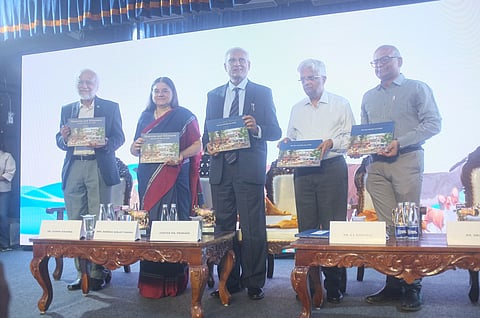
Authored by historian V Sriram and Lashman, the book was unveiled by Justice PN Prakash, former judge of the Madras High Court, in the presence of Maneka and AL Somayaji, former advocate general, Tamil Nadu.
Sriram, reflecting on writing the book, said, “This book began with interviews with Chinny. Then, the gods decided to send COVID, so the book didn’t advance a line. Finally, Nanditha Krishna pushed us to get it done. One of the great problems in Chennai’s history is that every few years, we have a flood. And floods don’t discriminate between people and archives — important files are always the first to float away! But we managed to salvage enough issues of Animal Voice to put this together.”
As the first copy was handed over, Somayaji took the mic. “I wondered why I was invited today. I still do. But I remember Chinny coming to me years ago, struggling to keep Blue Cross running. Despite their best efforts, they faced resistance — some challenges unworthy of mention. It’s frustrating that after 60 years of tireless work, the government still doesn’t fully recognise their impact. But Chinny and Nanditha have not let that deter them. And they still continue to provide their service.”
Sixty years ago, Blue Cross of India began with a simple act of kindness — rescuing two drowning puppies. Today, it stands as a testament to how relentless compassion can drive real change. From pioneering India’s first Animal Birth Control programme to influencing national policies, its impact is undeniable. But as speakers at the event reminded us, the challenges aren’t over. Thousands of animals are still abandoned, injured, and left voiceless every day.
The question is: how far are we willing to go to protect them?
