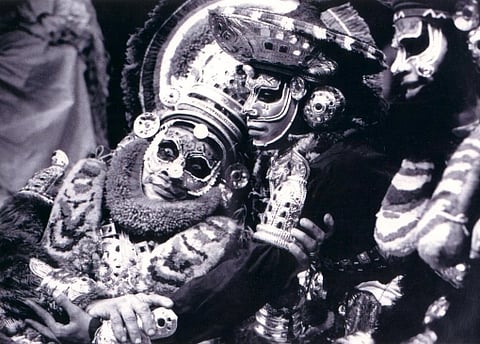

In the dim light of the nila vilakku (sacred lamp), as the beats of the mizhavu (drum) fades, a deafening silence amplifies as the valiant Bali comes to fall, struck by the arrow of Sri Rama. Playing the role of Bali, on that occasion, was the legendary Ammannur Madhava Chakyar, whose mastery is in how he prolongs the act of dying to nearly an hour, holding the attention of audience. As his breathing gets heavier, the audience let out their gasps; as his moaning grows painful, the audience feel choked in their throat. Immersed in the act, the audience will witness the prowess of the actor as he emotes intensely showing the light of life slipping away using his eyes.
Narrating the acting of Ammannur Chakyar is Venu G, his disciple, who shared that sitting in the audience, watching Chakyar perform on that day was Pina Bausch, a German dancer and choreographer, known for the neo-expressionist movement tradition. Moved by the intensity and profoundness in the dramatisation of Bali, Bausch expressed to Venu for an audience with him. Obliging the request, Venu ushered her backstage. On entering the greenroom, Ms Bausch went up to Ammannur Chakyar and prostrated in front of him, as an ultimate gesture of her appreciation. But in response, Venu shared how Chakyar had not even acknowledged her.
“He was definitely indifferent, making paan, and eating it.
That evening, when I was
walking him back to his residence, I asked politely of his behaviour.”
Quite simply, the reply of Chakyar was, “How do you think I should have behaved when I am merely the individual?”

Separating the ‘Individual - Actor - Character’
Turns out, the reply that Chakyar gave was a pearl of wisdom that could only come as a result of years of absorption, internalisation, integration and living of the text and tradition without differentiating them. Here is Venu explaining his revelations, “On that day, I realised that the reason for Ammannur Chakyar’s elevated artistry was not his ability to scale up in the journey from being an individual to being a character; but rather, his wisdom to not remain there upon mastering a character.”
To add another layer of context, Venu shared this entire episode of Pina Bausch and Ammannur Chakkyar when I asked him to comment on the meaning of wearing a vesham (character). He explained how an actor elevates to becoming an artiste only when one learns to differentiate the individual from the character; and an artiste becomes a master when he learns to disassociate the actor from both. How soon an artiste is able to come to terms with his realities, conveys the depth of their scholarship.
This episode also has a great lesson for rasikas, it can help separate the performers they come across in real life — those living the cause, as against those claiming to be saviours of it.
Navarasa Sadhana: a discipline that liberates the actor
Venu himself is no less when it comes to the scholarship and artistry of the Kodungallur kalari, the highly stylised school of Kutiyattam.
For an enhanced readership, Kodungallur (kotum-kall-r, meaning ‘place of the grand stone’), during ancient Tamizhakam was the ultimate resting place of Kannagi. There are historical accounts of the township for being the seat of knowledge, and often compared to Kasi and Kanchi. As for the art form, it was in Kodungallur, where a member of the Royal family developed this stylised classical theatre form that was passed on as a practice tradition to the Chakyars. The Royals seldom accepted students from outside the Chakyar communities only for the fact that students never measured up in showing the required austerity to become an adhikari (rightful claim of tradition).
Knowing the process, being an outsider, Venu had to wait three years for Ammannur Chakyar to accept him as his disciple. Albeit having crossed the threshold and proven his studentship, he still cannot perform Kootiyattam in the Kerala temples, but the acceptance he shows is his wisdom and grace. As much as it might sound as a social injustice to those outside of tradition, this is where time honors the artist and the art form stands to gain. Venu has contributed extensively to the expansion of the repertoire of Kutiyattam beyond the traditional plays of playwright Bhasa. Also, having stumbled on sura vayu, a very rare technique of breath during one of his practice sessions with Ammannur Chakyar, Venu has formulated it as a contemporary training module.
Navarasa sadhana is a workshop that integrates text and tradition by exploring the alternative actor within. Since a traditional performing body can many times feel entangled, due to the bundled memories of an unknown past, just one workshop of navarasa sadhana is enough to release the negative energies in the body of a sadhaka. The workshop is cathartic, its transformative content has made it very popular among the classical dancers and theatre actors.