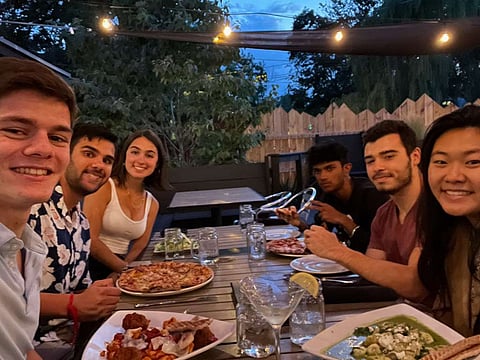

The characters and cultures we grow up watching in films and series often become our teachers of celebrations that aren’t quite our own. From the chaotic, yet value-adding, Thanksgiving episodes of the sitcom F.R.I.E.N.D.S, we learn American pop culture has long offered a window into traditions shaped by gratitude, food, and togetherness. Thousands of miles away in Chennai, those rituals are now being reimagined by American scholars, part of The United States-India Educational Foundation, who are building a sense of home.
Ajay Nadan, who has always celebrated the festival with his loved ones, says, “Thanksgiving to me is a holiday of showing gratitude and building community.” In the US, Ajay’s Thanksgiving celebration was dinners with immediate family, and friends. Celebrating Thanksgiving away from his “homeland”, looks a little different. “Here, it means connecting more with people that I’ve met recently. So, my meaning of Thanksgiving has evolved,” he adds.
His words echo the sentiment of the F.R.I.E.N.D.S episode where five of them come together to pool in money, so that Rachel could keep up with her Thanksgiving tradition of skiing with her family, but in the end, celebrates with her friends. Ajay says, “It is a bittersweet experience of celebrating away from parents and missing the comfort of familiar dishes. But it’s more of a matter of scope and also kind of finding family across the world.”
Food, Ajay says, is only a catalyst. “I’d love to have biryani on the table, too. But ultimately, Thanksgiving is about coming together and reflecting.” This year, he plans to gather and cook with other Fulbright Scholars.
For Siddarth Seenivasa, who has studied and worked in different cities, the holiday has shifted with geography. “[Previously], I’d take time off from work to go back home, see my family and old friends,” he says. And with time, the definition of celebration also evolved. He shares, “As kids, we often don’t understand the meaning of Thanksgiving. We think it’s when we get a week off from school, and stay at home. But as I grow older, I’m understanding the history behind the festival.”
The first commonly known Thanksgiving meal began as a three-day harvest feast in 1621 in Massachusetts, shared by English colonists and the Wampanoag people (Native Americans). The first national holiday was declared by President Abraham Lincoln in 1863, and it became a rich tradition when President Franklin D Roosevelt officially set the fourth Thursday in November as Thanksgiving Day in 1941.

This year, Thanksgiving falls on November 27. While Ajay plans to cook his meal with his friends, Siddarth is thinking about having dinner with people he’s grown close to during his time in the city.
For him, food remains an emotional anchor. “I’m a mac and cheese fan. So if there’s any way I could go get a box of mac and cheese here, I’m going to buy that,” he shares. Last year, he hosted a dinner, inviting “new co-workers and friends that I had just met in the past couple of months. People from other cultures, when invited, know that I’m willing to form a new connection with anyone. They leave knowing that Thanksgiving is inclusive, and mainly meant to thank and to foster new connections or to grow existing connections, regardless of your background,” he points out.
If he could bring Chennai to his American table, he would like to take Kollywood and introduce that his friends. “I would start with the 2001 Vijay and Suriya movie, Friends.”
As these scholars gather around improvised tables, their celebrations shaped by memories and new connections, they show how Thanksgiving, much like a good sitcom, evolves with every season of life.