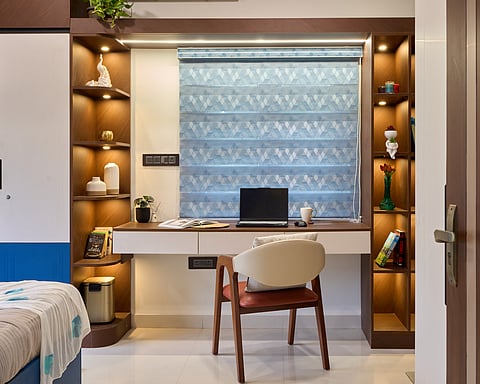

If the cupboard under the stairs conjures images of a young Harry Potter enduring the Dursleys’ wrath, you might be surprised to know that the same nook can transform into one of the most stylish and functional corners. From an open bookshelf to a sleek mini-office, the spandrel — the space beneath staircases — offers untapped potential for homeowners who are eager to make every square foot count.
Under-stair areas often feel awkward or neglected, yet designers see them as opportunities to infuse both style and purpose into a home. Keerthika Surenthar, co-founder of The Design Shop, highlights, “Every corner can tell a story if you let it… A curated display of travel memories, plants, or a softly lit art niche can make the under-stair space feel intimate and personal.” There are many ways to approach the space. It can be designed purely for function, but it can also be an opportunity to add personality and joy. Keerthika suggests functional uses such as storage cupboards, toy racks, or serene meditation nooks, emphasising a balance between utility and emotion.

Swathi and Sharath Kumar, founders and chief architects of Reflection Matters, believe that small spaces should be treated with intent and imagination, rather than just being unused corners. In one of their recent projects, they turned the space into a dual-purpose study and music corner for a child, complete with soft ambient lighting. In another, they created a showcase unit with integrated secret storage. “These spaces can be used for prayer nooks, mini libraries, pet zones, or reading pods — proof that the most successful designs are shaped by how homeowners truly live,” Swathi says.
While some designers approach small spaces with subtlety, others lean on efficiency and modular design. Mohammed Salman, co-founder of Tint Tone & Shade, and interior design content creator, says. “The under-stair space can be adapted in many ways: a compact study or workspace, a shoe rack or storage area, a crockery unit, or a cosy reading nook with throw pillows. The key is to ensure sufficient headroom so it’s both practical and comfortable.” Nivas R, Civil & Interior Engineer at Sperenza Interiors, complements this with his focus on maximising every inch. “My favourite ideas are open bookshelves or built-in storage with pull-out drawers for utilities. Keeping things open and accessible makes the room look larger and more organised.” He emphasises that homeowners should avoid cluttering spaces with oversized furniture or elaborate décor, as this can make even a well-planned room feel cramped.
Bijou balance
Choosing the right materials and colours can dramatically influence how a compact space feels. Keerthika recommends natural materials such as oak wood, ash wood, cane, linen, and muted lime finishes to evoke calmness. “Multi-functional furniture such as floating consoles or foldaway tables can make a space feel grounded yet flexible,” she notes. Swathi, too, believes that small rooms depend on visual openness and layered lighting. “I use task, ambient, and accent lights in layers to add depth. Combined with mirrors and pastel tones, they create a sense of openness and brightness,” she says, emphasising that “every element must earn its keep by being functional.” Salman concurs the role of multipurpose furniture — beds with drawers, wall-mounted desks, storage ottomans — reminding that “function should always come first, and style should enhance but never compete with it.” Nivas points out another dimension — efficiency and safety. “Opt for rounded-edge furniture to prevent bumps, choose washable, stain-resistant fabrics, and incorporate multifunctional storage to keep clutter minimal.” Lighting and ventilation are common threads across all their philosophies. Uthresh M, co-founder of Studio Scripted Aesthetics, adds, “Allowing natural sunlight to come in makes a space feel connected to the environment. Even if you want privacy, clerestory windows can bring in light without compromising comfort.”
Designers have utilised under-stair areas in innovative ways that reflect their clients’ lives. Uthresh recalls turning one such space into a playful “jumping pit” for children. In another project, he integrated a pet-friendly corner — a space for homeowners’ parrot, fish tanks and cat — into stair designs. In yet another house, the mid-landing of a staircase became a breakfast counter, while the space beneath stored kitchen utilities. “Traditionally, people go for landscaping or just dump their inverter there, but you can also use it creatively,” he says.
For Salman, it’s all about small-space efficiency. “Awkward corners can be transformed into charming feature spaces using pebbles, plants, and subtle lighting to create a mini indoor landscape. Careful planning ensures the space doesn’t feel cramped.” Keerthika adds emotional depth to this practicality: “A daybed can serve as a reading corner by day and an extra bed for guests by night… Thoughtful integration keeps a space stylish and emotionally connected.”
Modularity ties many of these concepts together. Murphy beds, fold-out desks, and wall-mounted shelves have become staples of small-space living. “Sliding walls, foldaway workstations, storage-integrated cots, and movable partitions let a single room serve multiple functions,” says Uthresh. Swathi takes it further with multi-purpose furniture that adapts to the user’s day: “In one of our projects, a compact zone seamlessly functioned as a dressing unit, work table, and movable seating area. The best small-space furniture doesn’t just save space; it transforms with the user’s lifestyle.”
Dual dimensions
While some designers rely on smart technology, others prioritise emotional warmth and tactile experiences. Nivas and Uthresh embrace automation and modular systems for efficiency. “Lighting, fans, and curtains were fully automated using voice control. Hidden storage inside walls and under seating keeps the room clutter-free,” says Nivas. Both ideologies, however, prove that there’s no single formula for small-space design, just infinite interpretations of creativity.
Trends in small-space living increasingly blend sustainability with adaptability. Modular furniture, concealed storage, and open layouts are gaining traction. Salman observes that “contemporary styles with traditional touches, tropical and coastal themes are trending.” Keerthika and Uthresh stress sustainability like reclaimed wood, bamboo, and energy-efficient LEDs. Uthresh also employs structural techniques like rat-trap brick bonds and infill slabs to enhance thermal comfort. Swathi concurs, “Small spaces work best when every decision is measured, intentional, and aligned with how the space will truly be used.”
The consensus remains that experimentation is key. A well-designed nook is more than a leftover; it’s a reflection of imagination. Whether it’s a reading pod, a hidden bar, a pet’s playground, or a hybrid workspace, the under-stair spandrel and every corner of the house can be transformed into a charming, efficient retreat. As Keerthika says, “The smallest corners often carry the most soul.” Swathi adds, “When practicality is thoughtfully resolved, style doesn’t have to fight for space.”
Make it up
Light & Bright: Pastel tones, mirrors, and slim furniture open up the space.
Layer Your Lights: Combine ambient, task, and accent lighting for depth and mood.
Smart & Modular: Murphy beds, fold-out desks, and hidden storage adapt to every need.
Safe & Stylish: Rounded edges, washable fabrics, and durable materials keep it practical.
Purposeful Décor: Define function first; add plants, a daybed or two long curtains to infuse personality.